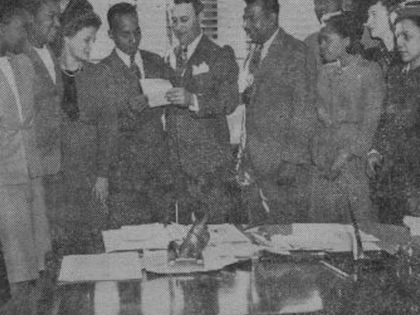
The Southern Negro Youth Congress’s Bold Push for Equality
Founded in 1937, the Southern Negro Youth Congress was a key player in the radical wing of the early phase of the civil rights movement.
Robert Greene II is an assistant professor of history at Claflin University and publications chair for the Society of US Intellectual Historians and lead associate editor for Black Perspectives.
Founded in 1937, the Southern Negro Youth Congress was a key player in the radical wing of the early phase of the civil rights movement.

Today is the 59th anniversary of the March on Washington, so get ready for plenty of whitewashed history. Here’s the truth: the Civil Rights Movement was a radical struggle against Jim Crow tyranny whose early foot soldiers were Communists and labor militants.

Conservatives are rushing to ban “critical race theory” from public schools, arguing it is ahistorical propaganda. But their own version of US history is a sterilized, hagiographic account that closes off connecting the issues of yesteryear with the problems of the present.

Hank Aaron will be remembered for his astonishing achievements as one of the all-time great baseball players, not least because he broke Babe Ruth’s home run record. But Aaron also ceaselessly fought to defend black people in a hostile, racist society.

With the death of John Lewis, we’ve lost another giant of the Civil Rights Movement. It’s up to us to carry on the struggle for the “beautiful community” he spent his whole life fighting for.

In the summer of 1990, Nelson Mandela toured the United States to raise money for the South African anti-apartheid struggle. His trip highlighted the historic links between the struggle for freedom in South Africa with the Civil Rights Movement in the US — a spirit of international solidarity that the US left must rekindle.

In the Red Summer of 1919, racist violence hit America as the Spanish flu ravaged the country. With mass protests against police murders sweeping the pandemic-plagued United States, it appears we might be now living in a Red Spring.

From the antebellum period to today, Southern white elites are terrified of poor whites and black workers joining hands — because they know it's an existential threat to their power.

Florida Republicans just passed a poll tax that disenfranchises many of the same felons who recently won the right to vote. It's a chilling throwback to previous eras of black voter suppression — and a reminder that we still have to fight for basic democratic rights today.

We should remember the Civil War and Reconstruction for what they were: periods of liberation that were snuffed out by white elites.

W. E. B. Du Bois's Black Reconstruction in America thrust African Americans into the role of historical actors and showed that the black freedom struggle has always been one for radical democracy.

On VE Day, we remember black Americans' Double V campaign: victory in Europe against fascism, victory at home against racism.
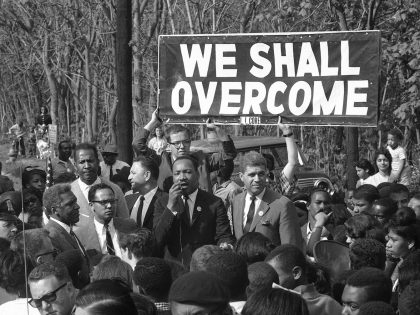
The Left struggles to speak with the kind of moral clarity Martin Luther King exemplified — but that shouldn't stop us from trying.

Black voters will be at the core of any resurgence in left politics in the South.

A look back at Liberator, an anticolonial magazine that operated during a golden age for black radical publications.

The Left can't allow itself to be consumed by debates about antifa. We need a proactive program and patient organizing.
More than five decades after its founding, the Black Panther Party's antiracist, anticapitalist vision remains just as relevant today.
African Americans were willing and able participants of the New Deal — reshaping the very meaning of American liberalism.
No political revolution in the United States can succeed without the South.

A new documentary on the Black Panther Party overlooks the group’s socialist core.