From Swords to Ploughshares
We’re held hostage by a political and military elite that exploits us to fuel its endless wars.
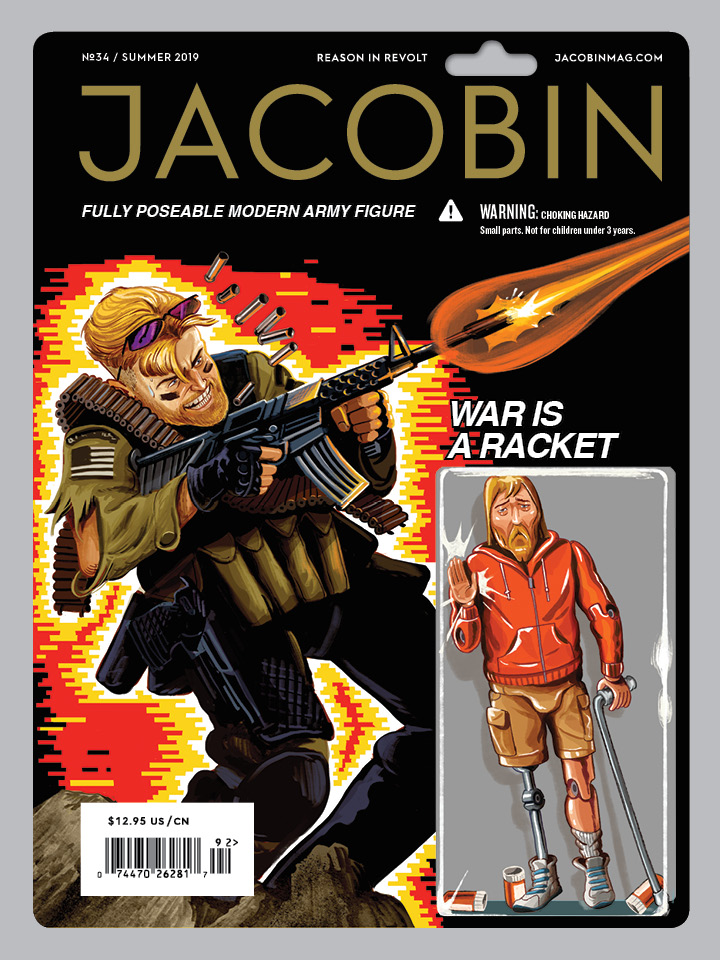
Issue No. 34 | Summer 2019
"War Is a Racket" is our longest issue yet at over 170 pages covering questions of the Left, militarism, and war.
We’re held hostage by a political and military elite that exploits us to fuel its endless wars.
Because communication is at the heart of any good relationship.
Inside the fight against JROTC, a Pentagon program that targets working-class teenagers at public schools.
How Rory Fanning went from Army Ranger to war resister.
For centuries, working-class people have been sent to die in wars for empire. The rich history of soldier revolt isn’t just about foreign policy — it’s about breaking the power of the mighty in society as a whole.
The United States has 800 military installations in dozens of countries around the world. They all must be dismantled.
Eighty years of American nuclear weapons policy.
Despite underfunding, the Veterans Health Administration is the United States’ largest health care system. And it could be the foundation of a truly socialist alternative to private care.
In 1992, the Cold War was over. But the Defense Department was already planning for the next one.
The foreign policy establishment is responding to Trump-era brutalities by demanding more, not less, aggression and empire.
Eisenhower’s warning about the “military-industrial complex” marked an era when the American right feared militarism could bankrupt the country and plunge it into socialism.
Your guide to military euphemisms.
Stefan Bertram-Lee was an internet leftist. And then they went to Rojava and got a gun.
British politics have become a strange form of World War II cosplay, where the European Union are the Nazis, 1945 is a betrayal, and Boris Johnson is the newWinston Churchill.
On HBO’s new tragicomedy, a veteran plumbs the depths of his combat record for the stage — but ends up painting a portrait of middle-American desolation.
Some of your favorite movies were probably made with help from the Department of Defense. Now we know which ones.
Though their time as a band was brief, the Monks represent a “what if” of the convergence between GI resistance and the 1960s counterculture.
We journey to Indian-occupied Kashmir, where the cinemas have been turned into torture chambers.
The GI Bill is proof: if people have access to education and the means to live, they’ll create meaningful art.
The military sets the agenda for scientific research, so it's still much easier to get funding to develop new bombs than to get the resources to develop new, potentially life-saving antibiotics.
For-profit colleges are making Wall Street firms even richer. Bush’s 2008 GI Bill helped make that possible.
Working people knew the war in Iraq was a mistake — but they didn’t have a media to speak for them.
The way to cut military climate emissions is to scale back the United States’ enormous empire. Elizabeth Warren has no plan for that.
Even for the United Nations, bombs and troops are increasingly the solution to problems created by an unjust global economy.
Taking stock of the Democratic field on US empire.
With its celebration of mercs rampaging through Africa, no healthy society could produce a magazine like Soldier of Fortune.
Endless war . . . it’s good work, if you can get it.
It’s possible to elevate the working class without the jingoism.
The life and times of Smedley Butler.
A. Philip Randolph called for a March on Washington to force President Roosevelt to abolish Jim Crow in the war effort, and shaped the trajectory of the postwar left.