
Sponsored Content
CONTACT US

Fire Ant Evolves: From Hypervisors to Trusted Infrastructure

First reported in 2025, Fire Ant remained active into 2026. Explore how the threat actor expanded beyond hypervisors into trusted infrastructure, compromising routers, authentication systems, and Linux management hosts to maintain covert access, collect credentials and traffic, and reach connected high-value environments.

Key Observations

  • First reported in 2025, Fire Ant remained active into 2026, expanding from hypervisor-level compromise into the trusted infrastructure layer that routes, authenticates, connects, and manages high-value environments.
  • The compromise impacted both the direct and third-party environments. Its trusted infrastructure relationships created potential reachability into connected external environments, including high-value networks and critical infrastructure. Fire Ant appeared to use this trusted position to explore access paths beyond the initially compromised environment. Compromised routers became operational platforms. Fire Ant used router infrastructure for covert connectivity, traffic collection, command-output manipulation, and suppression of logging.
  • Fire Ant targeted authentication chokepoints. The actor compromised TACACS infrastructure to intercept authentication flows, collect credentials, and weaken confidence in administrative audit trails.
  • Fire Ant built a resilient access layer. The actor deployed long-lived implants across Linux management infrastructure, including Medusa-related components, custom SSH backdoors, Zabbix-masquerading malware, and packet-triggered backdoors.
  • Fire Ant manipulated the evidence layer itself. Across routers, TACACS servers, and Linux hosts, the actor modified or bypassed telemetry sources defenders normally rely on, reinforcing the need to validate logs against memory, disk, network, authentication, and configuration evidence.

Executive Summary

Fire Ant, first reported in 2025, remained active in 2026 and expanded its operations beyond hypervisors into the trusted infrastructure that routes traffic, authenticates administrators, manages access, and records activity. The main finding is that the actor was no longer targeting only individual systems, it was targeting the infrastructure layer that controls how entire environments connect and operate both within and across organizational boundaries.

This created a “target behind the target” risk. By compromising routers, authentication systems, and Linux management hosts, Fire Ant gained strategic positions from which it could collect traffic and credentials, maintain covert access, and explore paths toward connected high-value environments, including critical infrastructure. The compromise therefore had implications beyond the systems directly affected.

The actor also manipulated the evidence sources defenders depend on. It suppressed router logging, altered command output, captured administrative credentials, tampered with host logs, and deployed multiple persistent backdoors. As a result, investigators could not rely on any single source of telemetry to accurately reconstruct the activity.

The key implication for organizations is that routers, authentication servers, hypervisors, jump hosts, and management appliances must be treated as first-class security and forensic assets. These systems require the same level of monitoring, hardening, and incident-response readiness as traditional endpoints and servers. When trusted infrastructure is compromised, an attacker can gain both a path into connected environments and the ability to obscure how that access was used.

From Hypervisors to Trusted Infrastructure

Fire Ant’s earlier activity showed that hypervisors can be more than platforms that host workloads. In the hands of an advanced actor, they can become privileged vantage points from which to reach guest systems, bypass segmentation and operate under the line of sight of many endpoint controls.

The 2026 activity expands this same principle to network and management infrastructure. The actor did not only pursue servers and workstations. It targeted systems that other systems depend on: edge routers, TACACS servers, Linux jump hosts and virtualized management servers. These are the systems that decide who can reach what, which credentials are trusted and which logs exist after the fact.

This is the continuity from 2025 to 2026. The technology changed, but the strategy remained consistent: operate from layers that are trusted, privileged and difficult to inspect.

The Target Behind the Target

Highly interconnected environments are strategically valuable because they sit between systems and network zones. They provide routing, managed connectivity, authentication paths, and operational access across connected networks. A compromised infrastructure layer can become a bridge to other environments.

This is the key difference from prior Fire Ant activity. The actor appeared to use the compromised environment as an infrastructure platform from which it could explore reachability into connected high-value networks, including critical infrastructure. In this model, routers, TACACS servers and jump hosts are not peripheral assets. They are the path to the target behind the target.

For defenders, this distinction matters. If the investigation focuses only on the initially compromised systems, it may miss the broader operational objective. If the investigation treats the network and management infrastructure as a trusted connectivity layer, the scope expands to connected routes, administrative paths, shared authentication infrastructure and the systems that control segmentation.
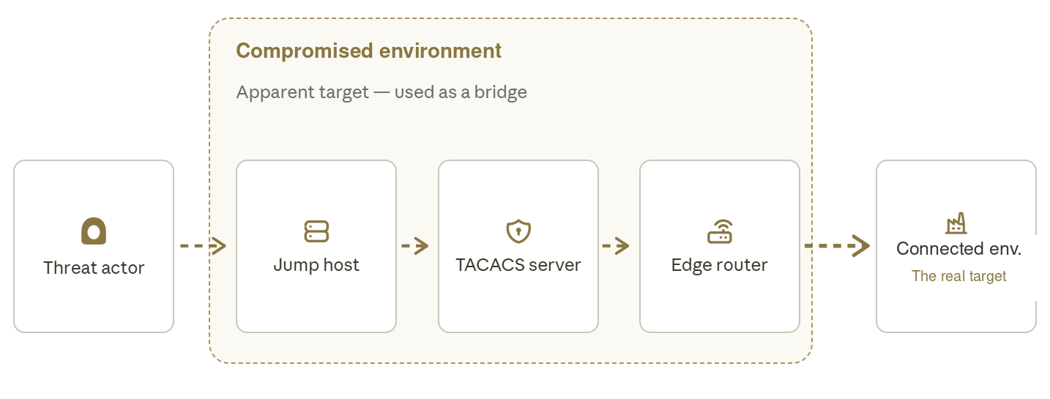
Figure 1: The compromised environment as a bridge into connected targets.

Compromising Network Infrastructure

Fire Ant’s activity demonstrated that edge routers should not be treated as passive network infrastructure. In this intrusion, the actor gained access to Cisco IOS XR routers and turned them into operational platforms capable of supporting stealth, persistence, and potential reach into connected environments.

The investigation began with an anomaly that appeared, at first, to be a configuration inconsistency: a tunnel interface became operational on a Cisco IOS XR router even though no corresponding running configuration or commit history could explain its creation. The interface was associated with a specific VRF and used GRE encapsulation, but standard configuration review did not provide a reliable explanation for how it appeared. This discrepancy became a key investigative lead because it suggested that the device’s operational state could no longer be trusted to match the configuration and audit records visible to administrators.

Inside Fire Ant’s IOS XR Router Toolkit

Fire Ant’s router compromise was not built around generic Linux tooling. The malware recovered from the compromised Cisco IOS XR environment was purpose-built for the router control plane, with components that interacted directly with IOS XR logging, command execution, routing, VRF resolution, AAA, and Telnet-management functions. This distinction is important: Fire Ant was not simply running malware on a Linux-based appliance; it was modifying the systems that make the router manageable and trustworthy.

The toolkit included a boot-themed persistence script on /etc/rc.d/init.d/grub-rommon masquerading as a legitimate service.

Figure 2: Masqueraded grub-common service used to monitor and launch the acpid implant.

This script monitored and launched the acpid implant from /usr/bin/acpid, using an hourly schedule that started the implant during odd-numbered hours and stopped it during even-numbered hours. The design suggests an attempt to maintain access while reducing continuous process visibility during routine inspection.

Figure 3: The persistence script starts acpid only during odd-numbered hours and stops it during

The acpid component embedded a modified IOS XR syslog library. In the modified evsyslog flow, log delivery was routed through a custom wrapper that checked for the string “Health” before calling mq_send. When the condition was not met, the wrapper returned a success-like value without forwarding the message, indicating selective manipulation of router log delivery.

Figure 4: Modified IOS XR syslog flow in acpid: log delivery is routed through sub_7000, which conditionally forwards messages to mg_send based on the presence of “Health”.

The acpid component also contained shell-related indicators, including references to pseudo-terminal paths, interactive connection banners, escape-sequence handling, and a command to unset shell-history environment variables. It indicates that acpid likely supported interactive access or shell staging in addition to its telemetry-manipulation role.

Figure 5: Shell-related strings in acpid indicate interactive session support, and shell-history suppression logic.

Another component, masquerading as /pkg/bin/dhcpd_show_issu_status, provided outbound connectivity. The binary contained a hardcoded external IP address and Telnet client functionality, while importing IOS XR-specific routing, VRF, RIB, and Telnet-management libraries. This indicates that the actor designed the communication component to operate from within the router’s native networking context rather than relying on standard Linux networking behavior.
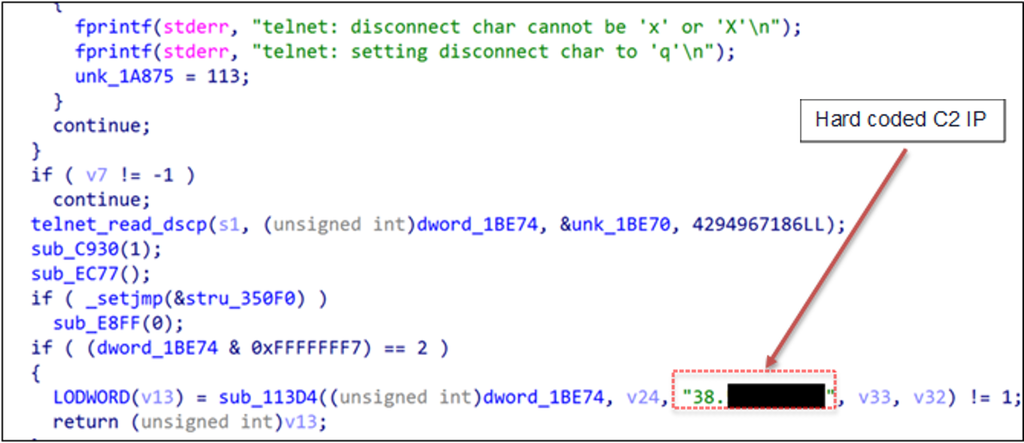
Figure 6: Telnet communication logic in dhcpd_show_issu_status passes the hardcoded C2 IP address into the connection flow after Telnet session setup and state checks

Fire Ant also attempted to manipulate what administrators could see from the router CLI. Reverse engineering of the recovered /pkg/bin/hd component showed that the actor modified the IOS XR command execution path to append an IOS-style “| exclude” filter to show commands before forwarding them to the normal shell_send_cmd() routine. Separately, command history from the affected device showed repeated show commands using exclusion filters that matched tunnel-related configuration elements, including the tunnel interface, VRF, tunnel source, tunnel VRF, and tunnel destination.

Taken together, these components show that Fire Ant treated routers as operational platforms. The actor built capabilities for persistence, outbound communication, syslog suppression, and command-output manipulation. In a highly interconnected environment, this level of router control is strategically significant: a compromised edge router can become a vantage point for covert connectivity, traffic observation, and access to connected networks, including critical infrastructure environments that rely on trusted routing and management paths.

Following the GRE Tunnel

The tunnel anomaly also shifted the investigation from the compromised router itself to the infrastructure it appeared to connect with. Once Fire Ant demonstrated the ability to manipulate the router’s configuration view, suppress telemetry, and potentially conceal operational state, the key question was no longer only how the tunnel was created, but where it led and what role the other side played in the operation. Tracing the far end of the GRE tunnel exposed another part of the actor’s infrastructure: a legacy Linux system.

Activity on the Linux system showed that the GRE tunnel was not only an anomalous configuration artifact; it was also an operational path. From this host, Fire Ant conducted repeated connection attempts and port probing toward connected high-value environments, including systems associated with critical infrastructure. The observed activity included attempts against common administrative and service ports such as SSH, HTTP/HTTPS, SMB/RPC-related ports and RDP. This indicates that the actor used the tunnel to extend reach beyond the compromised router and into environments reachable through the compromised network infrastructure.

Figure 7: /var/log/secure entries showing repeated sshd connect_to failures toward connected IP addresses and common service ports, indicating scanning activity routed through the Linux host.

This shifted the role of the Linux host from a passive tunnel endpoint to an active staging and reconnaissance node. On this system, investigators identified a suspicious binary named zabbix_agent. Although the name appeared to imitate a legitimate Zabbix monitoring component, the binary did not align with expected Zabbix behavior. Instead, it functioned as a backdoor that supported actor-controlled access and command execution from the Linux management host. The legitimate Zabbix agent is typically named zabbix_agentd, making the zabbix_agent filename a likely attempt to blend into a monitoring environment.

BridgeAgent

Sygnia tracks this Zabbix-masquerading implant as BridgeAgent, reflecting its role on the GRE-connected Linux host as a bridge for actor-controlled access into connected environments.

BridgeAgent is configured for persistence through a zabbix_agent.service systemd unit, set to run as root with automatic restart behavior. Once executed, BridgeAgent changed its apparent command line to resemble /usr/bin/gnome-shell, loaded encrypted configuration from /opt/.ICEauthority, and performed periodic HTTPS polling to retrieve controller-supplied configuration.

Figure 8: BridgeAgent execution flow: persistence through zabbix_agent.service, command-line masquerading as /usr/bin/gnome-shell, encrypted configuration stored at /opt/.ICEauthority, periodic HTTPS polling, and outbound TLS reverse-shell capability.

BridgeAgent stored its runtime configuration in encrypted form under /opt/.ICEauthority. Static analysis of the binary identified an embedded AES key used to decrypt this configuration. This design allowed the implant to keep C2 parameters out of plaintext on disk while still retrieving them locally at runtime.

Figure 9: BridgeAgent stores its runtime configuration as an encrypted blob, with an embedded AES key enabling local decryption of C2 parameters at runtime.

Using the recovered AES key, Sygnia decrypted the .ICEauthority configuration file and recovered the implant’s runtime settings, including controller host, port, polling interval, host identifier, and reverse-shell parameters.

Figure 10: Decrypted BridgeAgent configuration from /opt/.ICEauthority, revealing connection parameters used for outbound C2 polling and reverse-shell configuration.

BridgeAgent’s runtime logs showed repeated attempts to establish TLS-based outbound connectivity to actor-controlled infrastructure over port 443. The logs also showed the implant processing controller-supplied configuration and attempting to launch reverse-shell functionality, indicating that the malware was designed to operate as an outbound command-and-control backdoor rather than as a normal monitoring agent.

Figure 11: Journal logs showing BridgeAgent loading encrypted configuration, parsing controller-supplied connection parameters, and attempting TLS-based outbound communication to actor-controlled infrastructure.

Additional journal evidence showed BridgeAgent launching a secondary binary named ntfsfixed. The child process connected to actor-controlled infrastructure and included the magic string KS2ow2232ssww2342234323 in its command line. This suggests that BridgeAgent acted not only as a backdoor, but also as an execution mechanism for additional actor tooling on the Linux host.

Figure 12: Journal logs showing BridgeAgent launching the secondary binary ntfsfixed, which connected to actor-controlled infrastructure using a command-line magic string.

BridgeAgent’s role was therefore broader than simple backdoor access to a Linux host. The implant was positioned on infrastructure connected to the GRE tunnel and gave the actor an operational foothold at the boundary between the compromised environment and connected networks. From this position, Fire Ant could receive commands from external infrastructure, execute additional tooling, and use the tunnel path to explore reachability beyond the immediate victim environment.

Figure 13: The actor reaches BridgeAgent on the legacy Linux server, where a GRE tunnel provides a pivot to the edge router and opens a route into a connected environment.

Routers as Collection Points

After establishing access to router infrastructure, Fire Ant used the network layer as an intelligence source. The actor was observed capturing traffic from multiple Cisco routers and uploading the resulting PCAP files to external FTP infrastructure. This behavior shifts the router’s role from a transit device to a collection platform. once the actor controlled the router, the device became a vantage point for observing traffic moving through trusted network paths.

Figure 14: Router administration logs showing PCAP files exported from Cisco routers to external FTP infrastructure.

The activity was performed through router-administration workflows using a legitimate administrative account. Traffic captures were generated from multiple router interfaces and uploaded to external FTP servers. The observed activity involved several routers, indicating that the actor was not collecting from a single point of access but was selecting network vantage points from across the environment.

Router-based PCAP collection is especially valuable for infrastructure-focused actors. Packet captures from routers can expose internal topology, management connections, authentication flows, routing relationships, and traffic patterns between connected environments. Unlike endpoint collection, which gives visibility into a single host, router collection can provide a broader view of how systems, administrators, and connected networks interact.

The timing and preparation of the external FTP infrastructure also stood out. One of the FTP services used for the uploads appeared to have been installed on the same day the router PCAP upload activity occurred, suggesting that the actor prepared external collection infrastructure close to the operational window.

Additional router commands observed around the same administrative activity included access to command-history-related paths and traceroute activity toward unusual external domains. The pattern is consistent with an actor using routers for both collection and network reconnaissance.

This activity reinforces one of the core observations from the investigation: when a threat actor controls routers, they do not only gain reach. They gain perspective. Fire Ant used network infrastructure to observe the environment from the inside, collecting information that could support lateral movement, credential targeting, and cross-network access planning.

Owning the Authentication Layer

Fire Ant’s activity extended beyond the routers themselves into the systems used to authenticate and record administrative access to them. This is a critical distinction: the actor was not only abusing valid credentials but also targeting the infrastructure responsible for validating those credentials and preserving the audit trail.

On the TACACS server, investigators identified a VMCI-socket-based backdoor deployed under /var/tmp/audit. The backdoor supported communication over VMware VSOCK/VMCI interfaces, providing an access path that would not necessarily appear as a normal network login to the guest operating system. This finding connected the TACACS compromise back to Fire Ant’s broader pattern of abusing virtualization-adjacent access paths.

Figure 15: The /var/tmp/audit backdoor contains VSOCK/VMCI logic, including AF_VSOCK socket creation and fallback access to VMware VSOCK device paths.

TacTap

The investigation also identified a malicious binary, /usr/sbin/acppid. Sygnia tracks this TACACS credential-collection toolset as TacTap. TacTap should be understood as a multi-component mechanism rather than a single binary: /usr/sbin/acppid acted as the injector and collection process, while /lib/libseconfd.so operated inside the tac_plus process. Together, the components enabled library injection, accepted-session interception, Unix-socket file-descriptor handoff through /var/run/acpid.lock, and creation of the XOR-obfuscated credential artifact at /var/log/.tacplus.acct

Reverse engineering of acppid showed that the binary was designed to maintain a malicious shared object inside the TACACS daemon. The original IDA view shows that acppid retrieves optional runtime configuration from the TARGET_PROG and SO_PATH environment variables. If those values are not provided, it defaults to targeting the tac_plus process and using /lib/libseconfd.so as the shared object path.

Figure 16: Reverse engineering of accpid showing default targeting of the tac_plus process and loading path for the malicious shared object /lib/libseconfd.so

To improve readability, the next snippet is a simplified pseudocode reconstructed from the binary. It preserves the relevant injection logic while omitting decompiled artifacts and unrelated error handling.

Figure 17: Simplified pseudocode reconstructed from acppid, showing how the implant locates tac_plus, checks whether /lib/libseconfd.so is already mapped, writes the embedded payload, invokes the injection routine, and removes the on-disk library afterward.

The injected library, libseconfd.so, was designed to operate inside the TACACS process. Reverse engineering showed that it hooked accept and accept4, placing the implant inside the TACACS session-handling path. This allowed the malicious code to interact with newly accepted TACACS client connections from within the service process itself.

The hook then forwarded accepted connection file descriptors to acppid through a local UNIX socket at /var/run/acpid.lock, using sendmsg-style file-descriptor passing. This design allowed one malicious component inside the TACACS process to hand live connection handles to another process, enabling the actor to observe or process TACACS session material from within the authentication flow.

Figure 18: After intercepting accepted TACACS connections, libseconfd.so forwards the accepted socket file descriptor to acppid over /var/run/acpid.lock.

The operational result of this access was visible in the recovered credential artifact. Investigators identified an encrypted file at /var/log/.tacplus.acct containing TACACS-related credential material. The file was encoded using a single-byte XOR scheme, indicating that the actor attempted to lightly obfuscate the harvested data while keeping it simple to recover operationally. This artifact connects the injection and session-handoff mechanism to credential collection from the authentication layer.
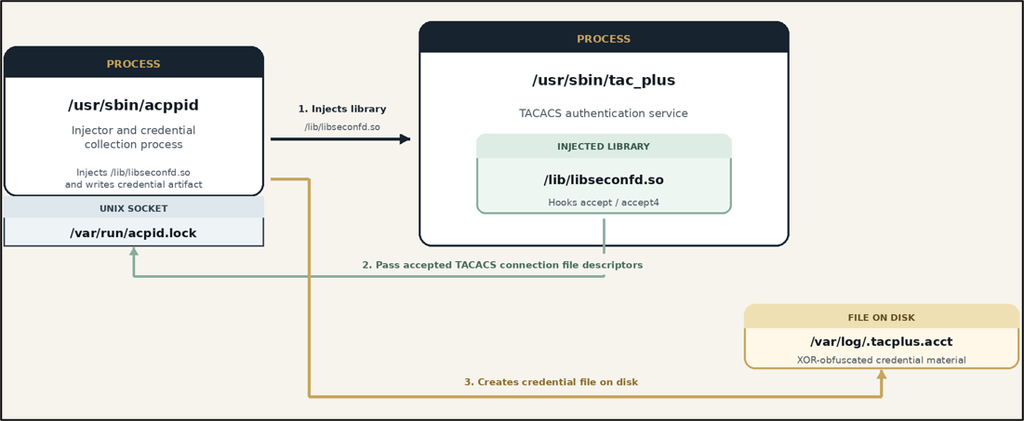
Figure 19: TACACS malware workflow showing library injection, accepted-session handoff through a UNIX socket, and credential artifact creation

The recovered /var/log/.tacplus.acct file was decoded using a single-byte XOR operation with key 0xEF, revealing TACACS-related credential material. The key choice is notable because Mandiant previously documented UNC3886 TACACS credential-collection tooling in which captured credential records were also XORed with 0xEF before being written to a credential log file. In this case, however, the more significant finding is the collection mechanism itself: Fire Ant used acppid to inject libseconfd.so into the running tac_plus process, intercept accepted TACACS sessions, pass connection file descriptors back through /var/run/acpid.lock, and write the resulting credential artifact to /var/log/.tacplus.acct. To our knowledge, this specific tac_plus library-injection technique has not been publicly described before, making it a notable evolution of Fire Ant’s TACACS-focused credential collection tradecraft.

Figure 20: CyberChef decoding of /var/log/.tacplus.acct using single-byte XOR key 0xEF, revealing TACACS-related credential material.

This technique is more significant than ordinary credential theft. TACACS servers sit at an administrative chokepoint: they authenticate users, authorize commands, and record activity across network devices. By compromising this layer, Fire Ant positioned itself close to the trust boundary between administrators and infrastructure. The actor could potentially harvest credentials as they were used, observe administrative activity, and create ambiguity between legitimate account use and malicious activity.

The lesson is clear: when the authentication layer is compromised, defenders can no longer ask only “which account performed the action? They must also ask whether the system recording that action can still be trusted.

Building the Access Layer

Fire Ant did not rely on a single foothold. Across Linux management infrastructure, the actor built a durable access layer using Medusa-rootkit, custom SSH backdoors, masqueraded binaries, credential capture, and host-level configuration changes. The objective was not only to compromise Linux hosts, but to convert them into reusable operational infrastructure.

A key feature of this access layer was its duration. Several Linux access components were deployed in 2025 and remained available into 2026, when Fire Ant was later observed using them for hands-on activity. This shows that the actor treated Linux management hosts as long-lived staging and access nodes, not temporary footholds.

The long-lived nature of this access layer was visible in the Linux bodyfile timeline. Several Medusa-rootkit-related and custom SSH backdoor artifacts were created in 2025, including files under /usr/lib/locate and binaries such as /usr/sbin/cupsdd and /usr/sbin/smartdd. These artifacts remained relevant into 2026, when Fire Ant later launched hands-on activity through the same access layer

Figure 21: Linux bodyfile timeline showing 2025 creation of Medusa-rootkit-related and custom SSH backdoor artifacts, with later 2026 activity demonstrating reuse of the long-lived access layer.

The names cupsdd and smartdd appear designed to blend in with legitimate Linux service names: cupsd, the CUPS printing daemon, and smartd, the smartmontools storage-health daemon.

One example of this reuse was the custom SSH backdoor /usr/sbin/cupsdd. The process tree below reflects 2026 operator activity launched through the prepositioned access layer, rather than initial deployment. Through cupsdd, Fire Ant staged and executed additional tooling from /var/tmp, including client and se.py, to support reverse-shell and tunneling activity. Because this access path operated outside the normal SSH service flow, it likely reduced the forensic footprint expected from a conventional SSH session.

Figure 22: Process tree showing 2026 threat actor activity launched from /usr/sbin/cupsdd, including file staging, permission changes, execution of client, and reverse-tunneling activity through se.py.

Fire Ant also reinforced this access layer with credential capture. The file /var/log/remote.txt contained harvested SSH credentials from user sessions, providing the actor with a credential-based fallback alongside its implants. This meant that even if an implant was removed or a backdoor was discovered, the actor may still have retained reusable credentials for future access.

Figure 23: Contents of /var/log/remote.txt showing captured credentials from user accounts on the Linux management host.

The actor also used process masquerading to make malicious tooling appear legitimate. Fire Ant staged a binary named /var/tmp/ping, renamed it to resemble the endpoint security software, SentinelOne, moved it into a directory associated with the security agent, modified timestamps to match legitimate SentinelOne files, and executed it from that trusted-looking path. In another case, the same style of masquerading was observed under a Cybereason-like path.

Even after the executable was removed from disk, the process remained active in memory. This demonstrates how Fire Ant combined trusted naming, timestamp manipulation, and deleted-but-running execution to hinder defender analysis and reduce the value of disk-only triage.

Figure 24: Deployment process and defense evasion techniques used by Fire Ant during ping deployment
Figure 25: Memory analysis showing the masqueraded binary is active in memory

The deleted executable was later recovered from memory for analysis. Analysis showed that the binary initially staged as /var/tmp/ping and later disguised under an endpoint-security path was not a simple reverse-shell launcher. Instead, it was a packet-triggered backdoor that inspected raw network traffic for embedded activation markers before establishing operator access.

The binary showed strong functional and code-level overlap with REPTILE-style tooling publicly associated with UNC3886. Similar to REPTILE, it created a raw Layer-2 packet socket, parsed received packets directly, and searched for magic strings before activating. Notably, the sample reused the “hpaVAj2FJ“ kill marker, which has been publicly documented as a REPTILE kill marker. However, the sample was not identical to the previously reported REPTILE implementation: its primary activation marker was “sxcdewqaz!@#” rather than “mznCvqSBo”, and its packet-decoding logic differed from the date-derived XOR routine described in earlier reporting.

The ping binary also showed operational linkage to the earlier se.py activity through the same magic string, “sxcdewqaz!@#”, which was observed in the actor’s connect-back workflow. This suggests that the actor reused a common activation or session-control marker across multiple access components, while adapting the underlying implementation and filenames.

Packet triggered function

Analysis showed that the malware is a raw packet triggered remote-access controller, that listens on the network interface for TCP packets destined for ports 443, 541, 8443, or 10443, and UDP packets sent from source port 40443 and destination port 500. The malware looks for network packets with two magic strings within the packet.

  • sxcdewqaz!@# -> Start of packet
  • hpaVAj2FJ-> End of packet/kill marker of the listener child process
Figure 26: Packet-trigger logic showing the implant parsing IPv4 ICMP echo traffic and searching for embedded magic strings used to activate or control the backdoor.

The code below shows that the implant monitored raw IPv4 Ethernet traffic and accepted activation data through:

  • TCP destination ports 443, 541, 8443, and 10443
  • UDP source port 40443 to destination port 500

    0x9DFB is decimal 40443
Figure 27: Trigger-port filtering logic showing the implant monitoring TCP destination ports 443, 541, 8443, and 10443, as well as UDP traffic from source port 40443 to destination port 500.

A second magic string, ;7(Zu9YTsA7qQ#vw, appeared to mark command completion, file-transfer completion, or control-session termination.

Figure 28: Control-session handling logic showing the implant checking for the magic string ;7(Zu9YTsA7qQ#vw, likely used to mark command completion or session termination.

Interactive PTY Shell

The malware creates a PTY pair; the master side is for controlling process to send and receive data while an interactive shell is attached to the slave side. By setting the HISTFILE value to null, the bash history logging is disabled. Hence, the commands executed by the threat actor could not be seen from the .bash_history file. However, analysts can rely on other log sources such as journal log and EDR telemetry.

Figure 29: Interactive shell setup showing PTY-related logic and HISTFILE= manipulation to suppress bash history logging during operator activity.

The malware also handled terminal settings from the remote peer, including terminal type and window dimensions. This allowed applications launched inside the remote shell to behave as though they were connected to an operator-controlled terminal.

Figure 30: Terminal-handling logic showing the implant receiving the remote terminal type, setting TERM, and processing terminal window dimensions to support an interactive PTY session.

Fire Ant reconfigured the configurations of the compromised Linux management hosts so that they could sustain and relay access rather than simply running an isolated malware. The actor weakened or disabled SELinux, modified iptables rules governing SSH, redirected selected inbound connections from port 22 to port 443, and enabled IPv4 forwarding. These changes turned the Linux management hosts into covert access and tunneling nodes capable of receiving traffic on an alternative port and forwarding it onward into the environment.

Figure 31: Commands used by Fire Ant to allow malicious files to stay undetected and facilitate communication between infected machines

This design provided Fire Ant with an independent fallback channel that did not depend on the host’s legitimate SSH service or a continuously listening application port. The process could remain dormant until a valid trigger arrived, while support for ICMP, TCP, and UDP gave the actor several possible paths through network controls. Combined with masquerading as legitimate files, timestamp manipulation, deleted-but-running execution, cupsdd, Medusa-related persistence, and reverse-tunneling tools, the implant strengthened Fire Ant’s layered access architecture: removing one binary or closing one service would not necessarily eliminate the actor’s ability to return.

Making the Infrastructure Lie

Across the observed activity, Fire Ant repeatedly targeted the reliability of telemetry itself. The actor did not just seek to remain unseen. It modified, bypassed or removed the systems defenders normally use to reconstruct an intrusion.

On network devices, the actor manipulated the evidence layer by hiding logs, hiding commit activity, suppressing AAA requests, suppressing SNMP traps and filtering command output. On Linux systems, the actor deleted files after execution, left processes running from deleted paths, disabled SELinux, tampered with logs and modified firewall rules. On access appliances and management paths, incomplete command and authentication telemetry created ambiguity around how specific SSH sessions were established.

The result is a fundamental investigative problem: the environment may contain evidence, but the evidence sources may no longer be fully reliable. For this class of actor, defenders cannot simply collect logs and assume they represent ground truth. They must validate logs against memory, disk, network telemetry, authentication records, configuration state, and independent external observations.

Fire Ant anti-forensic activity on the Linux management hosts was selective. The actor replaced the Cisco router’s IP address with an internal IP address within three authentication artifacts, /var/log/wtmp, /var/log/utmp and /var/log/btmp.

Figure 32: Commands used to rewrite Linux login-history artifacts by replacing references to with in wtmp, utmp, btmp, and lastlog.

Fire Ant removed sudo-related entries from /var/log/messages and /var/log/secure, reducing the reliability of standard Linux audit artifacts.

Figure 33: Commands used to remove sudo-related entries from Linux log artifacts, reducing visibility into privileged activity and weakening forensic reconstruction.

By disabling or weakening SELinux, the actor reduced a host-level control that could otherwise constrain post-exploitation behavior, even for privileged processes.

Figure 34: Content of a modified /etc/selinux/config file where SELinux is disabled.

Threat Intelligence Context

Fire Ant’s activity should be understood in the broader context of infrastructure-focused espionage tradecraft. Public reporting from Mandiant and Google Cloud describes UNC3886 as a China-nexus espionage cluster with a sustained focus on virtualization platforms, edge devices and network infrastructure. Sygnia assesses that Fire Ant activity strongly overlaps with this public reporting.

The overlap is strongest at the level of durable behavior. Public reporting has described VMCI-based backdoors, TACACS credential theft, Medusa-rootkit usage, custom SSH access, and router-focused operations. Sygnia’s 2026 observations contain the same operational themes: virtualization-adjacent access, credential capture from authentication infrastructure, Linux rootkits, custom SSH backdoors, router compromise, and deliberate telemetry suppression.

The differences are also important. Several filenames, paths and deployment details differ from public reporting. This should not be treated as a contradiction. For mature actors, atomic indicators often change after exposure, while the operating model remains stable. In this case, the stronger correlation comes from how the actor uses infrastructure, not from whether every path or filename matches a previous report.

Fire Ant’s Objective

The new intelligence value from Sygnia’s observations extends the model into a highly interconnected environment where routers, TACACS servers and Linux management hosts were used as part of a broader access and collection layer. This reinforces the view that Fire Ant/UNC3886-like operations are not endpoint-centric campaigns. They are infrastructure-control-plane campaigns.

From a threat intelligence perspective, this also clarifies the likely objective behind the activity. In a highly interconnected environment, routers, TACACS servers, virtualization platforms, and Linux management hosts are not only internal systems; they are part of the trusted infrastructure layer that connects, authenticates, and manages access across connected networks. Compromising this layer can provide an actor with more than just persistence inside the immediate victim. It can create a bridge toward other high-value environments, including critical infrastructure that depends on trusted routing, authentication and management relationships.

This reinforces the “target behind the target” concept introduced earlier in this report. Fire Ant’s interest in the compromised organization should be understood not only as an attempt to compromise a single environment, but as an effort to control infrastructure that may enable visibility, collection, and potential access beyond the immediate victim. The strategic value lies in the trust relationships the organization maintains with connected environments.

Fire Ant’s Operating Model

The findings can be summarized as a four-part operating model. Fire Ant first seeks control over infrastructure systems, then uses those systems to collect intelligence and credentials, builds durable access, and conceals activity by manipulating the evidence layer.

This model is useful because it moves defenders beyond isolated IOCs. A single filename may change. A path may vary. A hash may disappear after remediation. The actor’s operational requirements, however, remain consistent: reach privileged infrastructure, understand routes and trust relationships, harvest credentials, maintain covert access, and weaken the reliability of telemetry.

PhaseWhat Fire Ant doesDefender implication
ControlCompromises routers, hypervisors, TACACS servers, jump hosts and access appliances.Scope must include infrastructure that controls reachability, not only business workloads.
CollectCaptures traffic, extracts credentials and enumerates routes, users, histories and access paths.Collection may look like administration or troubleshooting unless correlated across systems.
Build accessDeploys rootkits, custom SSH, masqueraded binaries, VMCI backdoors and scheduled persistence.Remediation must assume multiple access paths and credential reuse.
ConcealSuppresses logs, AAA, SNMP, command output, process artifacts and file evidence.Investigations must validate telemetry through independent evidence sources.

Figure 35: Fire Ant operating model and defender implications.

When Trusted Infrastructure Becomes the Target

Fire Ant’s recent activity shows that mature espionage actors are no longer focused only on endpoints, servers, or cloud workloads. They are increasingly targeting the infrastructure that sits between environments: routers, hypervisors, TACACS servers, access appliances, Linux management hosts, and the systems that create trust, reachability, and visibility.

In this campaign, the compromised environment was not only a victim. By compromising infrastructure that routes traffic, authenticates administrators, manages access, and records activity, Fire Ant turned the environment into a potential access path toward connected high-value networks, including critical infrastructure. This position allowed the actor to explore reachability beyond the initially compromised environment while also weakening the evidence sources defenders rely on to understand what happened.

The central lesson is that defenders must protect more than the systems that store sensitive data. They must protect the infrastructure that makes other systems reachable, trusted, and observable. When that layer is compromised, the impact extends beyond a single organization: the actor may gain a vantage point for collection, a path toward connected targets, and the ability to make trusted infrastructure tell an incomplete story.

Threat Hunting and Detection Opportunities

Hunting Fire Ant requires defenders to prioritize behaviors and asset roles over atomic indicators. The most important question is not simply whether a known file exists. It is whether infrastructure systems are exhibiting behavior consistent with control-plane abuse, credential capture, collection or evidence manipulation.

The following hunting guidance is organized around the systems most relevant to the actor’s operating model.

Asset classHigh-signal hunting leads
Network devices• Unexpected GRE or tunnel interfaces
• Configuration state that differs from command output
• PCAP generation from routers
• FTP/SCP from routers
• Command-accounting gaps
• Shell access
• Memory anomalies in legitimate network-device processes.
• Traceroute or reachability testing to unusual external destinations
TACACS / AAA servers• Tac_plus process injection
• Credential-like artifacts under log or temporary directories
• Command activity without corresponding login sessions
• Unexplained encryption or xor-encoded files.
Linux jump hosts and management servers• Selinux disabling
• /var/tmp staging
• /usr/lib/locate artifacts
• Deleted-but-running processes
• Custom SSH listeners
• Suspicious iptables NAT or port redirection
• Service names that imitate legitimate daemons or security agents.
Security-agent masquerading• Unexpected binaries under security-agent directories
• Security-agent-like processes that spawn shells, Python, scp, or network tools
• Timestomped files matching nearby legitimate agent timestamps
Tunneling and scanning activity• Repeated /var/log/secure entries containing sshd: error: connect_to … port … failed
• Linux hosts with GRE tunnel configuration that are not approved network devices
Linux log and login-record tampering• Use of utmpdump against /var/log/wtmp, /var/log/utmp, or /var/log/btmp
• sed replacement of IP addresses inside login-history artifacts
• sed -i ‘/sudo/d’ against /var/log/*

Figure 36: Fire Ant threat hunting and detection opportunities

Indicators of Compromise

The following indicators are selected for defensive use and have been sanitized to remove victim-specific identifiers. Organizations should treat them as starting points for hunting rather than as complete detection logic.

filenameSHA1Role/Description
/bin/atdC164BFC953C66E58B11FC280E69FD43B8F255839Custom SSH backdoor
/bin/gdm          Medusa-rootkit-related component
/usr/sbin/cupsdd1aa6ab2006b5d9199aa87bb0bbd995aec698ac4fCustom SSH backdoor.
/usr/sbin/smartddc164bfc953c66e58b11fc280e69fd43b8f255839Medusa rootkit binary.
/opt/cybereason/sensor/bin/cybereason-agent/cybereason-agentREPTILE like binary renamed to masquerade as Cybereason agent.
/opt/sentinelone/bin/sentinel-agent/sentinel-agentREPTILE like binary renamed to masquerade as SentinelOne agent.
/usr/lib/locateMedusa rootkit working directory.
/usr/lib/locate/.backup_ld.soMedusa rootkit-related file.
/usr/lib/locate/.lMedusa rootkit-related file.
/usr/lib/locate/.pdMedusa rootkit-related file.
/usr/lib/locate/.ptsMedusa rootkit-related file.
/usr/lib/locate/boot.shCusotm SSH backdoor and Medusa-rootkit startup script
/usr/lib/locate/libdl.soHijacked shared object associated with Medusa rootkit.
/usr/lib/locate/local.txtMedusa rootkit-related file.
/var/log/remote.txtCredential log associated with Medusa-rootkit activity.
/usr/sbin/acppid36005f5e4398a1c62a2a9271eddfcc1b44b1ad00TacTap -Injector targeting tac_plus; injects /lib/libseconfd.so and listens on /var/run/acpid.lock.
/lib/libseconfd.so955cd45a2f6f226a2fdf44b329af1c8dde90cb38TacTap – Injected TACACS library loaded into tac_plus; intercepts accepted TACACS sessions and sends descriptors to /var/run/acpid.lock.
/var/log/.tacplus.acctTacTap – XOR-obfuscated TACACS credential artifact
/var/run/acpid.lockTacTap – Unix socket used by acppid to receive accepted TACACS connection file descriptors.
/var/tmp/.bashrcThreat actor shell initialization file used with bash rcfile execution.
/var/tmp/audit13f0c2a598e3aa63856c032a96b110aed963f0e8VMCI/VSOCK-based backdoor providing shell access through virtualization-adjacent channel.
/var/tmp/esv3XArchive
/var/tmp/hourglass-cnThreat actor-run script.
/var/tmp/ping5ba1242050b5b447052b210788a5a25593d6987dREPTILE like binary later renamed to masquerade as security agent processes.
/var/tmp/sync7dab017f14628345d47bd4eb69cc49224f3054a7Tineyshell
/var/tmp/tacacs.pcapTACACS packet capture artifact created by Fire Ant
/var/tmp/ttt.tarThreat actor-created archive.
/var/tmp/u6.pyThreat actor-created Python script.
a.zipThreat actor-created archive.
cli.tarThreat actor-created archive.
clientMalicious client component executed by the threat actor.
se.pyThreat actor script used for reverse connection / pivoting activity.
ttt.zip.encThreat actor-created archive.
/usr/bin/acpidbe6b27f429324a4af05a310d8ec9635e37c68a94IOS XR implant
/pkg/bin/dhcpd_show_issu_status1682b652a15bde732489f22809b0b7594c228fd3IOS XR implant
/pkg/bin/hdb149fa3a34bd585e7a674a4fd9538437bd06f514IOS XR implant
/etc/rc.d/init.d/grub-rommon6ef7d2985edf743ebff413a9298a127e9475d72fMasqueraded startup script used for persistence

Yara Rules

rule FIREANT_BridgeAgent_Backdoor
{
    meta:
        description = "Detects Fire Ant BridgeAgent Linux backdoor"
        author = "Sygnia"
        sha256 = "110e6fb23be00d2ed251a445ee5b65aadf23b48b8db7419900d64539ad90c5a3"

    strings:
        $s1 = "[+] ########## GetRemoteCfg ##########" ascii
        $s2 = "[+] ########## ParseJson ##########" ascii
        $s3 = "[+] reverse_shell..." ascii
        $s4 = "If you want me to fake your argv, you need to call the program with a longer name." ascii
        $s5 = "/message/" ascii
        $s6 = "thread: running timeout" ascii
        $s7 = "fMDJLBukHuXgtFsCW68o5Zs1qGf" ascii
        $s8 = "2y7b4BSVukszyZz2vuZMppaA4" ascii
        $aes_key = { 07 FA AA 79 67 F1 3F 26 22 8F 5E 9A C9 0B F1 54 }

    condition:
        uint32(0) == 0x464C457F and
        5 of ($s*) and
        $aes_key
}

rule FIREANT_BridgeAgent_Systemd_Unit
{
    meta:
        description = "Detects the companion systemd service from the analyzed sample"
        author = "Sygnia analysis"
        sha256 = "251c7a2684542c29ae2c1e1282b780163bf9f844179ef0759094b2b7e2f62f0f"

    strings:
        $a = "Description=Service for zabbix hosted on PVE" ascii
        $b = "Type=forking" ascii
        $c = "ExecStart=/usr/sbin/zabbix_agent 60" ascii
        $d = "Restart=always" ascii
        $e = "User=root" ascii

    condition:
        all of them
}
rule FIREANT_TACTAP_LIBSECONFD_1 {
    meta:
        author = "Sygnia"
        description = "Detects TacTap injected TACACS library component"
        family = "TacTap"
        component = "libseconfd.so"
        sha1 = "955cd45a2f6f226a2fdf44b329af1c8dde90cb38"
    strings:
        $lib_name = "libseconfd.so" ascii
        $old_accept = "old_accept" ascii
        $old_accept4 = "old_accept4" ascii
        $lib_main = "_lib_main" ascii
        $accept_filter = "accept_filter" ascii
        $accept4_filter = "accept4_filter" ascii
        $plthook1 = "plthook_open_by_address" ascii
        $plthook2 = "plthook_replace" ascii
        $sendmsg = "sendmsg" ascii
        $proc_maps = "/proc/self/maps" ascii

        $acpid_lock_stack = {
            48 BE 2F 76 61 72 2F 72 75 6E
            48 89 30
            48 B9 2F 61 63 70 69 64 2E 6C
            48 89 48 08
            C7 40 10 6F 63 6B 00
        }

    condition:
        uint32(0) == 0x464c457f and
        uint8(4) == 2 and
        uint8(5) == 1 and
        uint16(16) == 3 and
        uint16(18) == 0x3e and
        filesize < 64KB and
        all of them
}

rule FIREANT_TACTAP_ACPPID_1 {
    meta:
        author = "Sygnia"
        description = "Detects TacTap acppid TACACS injector component"
        family = "TacTap"
        component = "acppid"
        sha1 = "36005f5e4398a1c62a2a9271eddfcc1b44b1ad00"

    strings:
        $target_prog = "TARGET_PROG" ascii
        $so_path_env = "SO_PATH" ascii
        $target_proc = "tac_plus" ascii
        $so_path = "/lib/libseconfd.so" ascii
        $socket_path = "/var/run/acpid.lock" ascii
        $proc_maps = "/proc/%s/maps" ascii
        $proc_comm = "/proc/%s/comm" ascii
        $dlopen = "__libc_dlopen_mode" ascii
        $attach_err = "waitpid error while attaching: %s" ascii

    condition:
        uint32(0) == 0x464c457f and
        uint8(4) == 2 and
        uint8(5) == 1 and
        uint16(16) == 2 and
        uint16(18) == 0x3e and
        all of them and
        @target_prog < @so_path_env and
        @so_path_env < @target_proc and
        @target_proc < @so_path and
        (@so_path - @target_prog) < 0x100
}

Related Resources


Sygnia Reveals New Activity by China-Nexus Threat Actor Fire Ant Targeting Trusted Infrastructure
Press Release

Sygnia Reveals New Activity by China-Nexus Threat Actor Fire Ant Targeting Trusted Infrastructure

Incident Response leader reveals long-running espionage activity abusing routers, authentication systems and Linux management hosts to collect intelligence and explore paths toward connected high-value environments.
How to Secure Enterprise AI: From Adoption to Incident Readiness
Guides and tools

How to Secure Enterprise AI: From Adoption to Incident Readiness

Learn where AI risk lives across the enterprise and how to secure AI across its full lifecycle with Sygnia’s practical AI security framework.
Shai-Hulud in the Wild: What Security and IR Teams Need to Know
Webinars

Shai-Hulud in the Wild: What Security and IR Teams Need to Know

What happens when software supply-chain attacks compromise not only packages, but the trusted systems and workflows used to build and distribute them?
Incident Response vs. Crisis Management: Why Treating Them as the Same Thing Is Dangerous
Blog

Incident Response vs. Crisis Management: Why Treating Them as the Same Thing Is Dangerous

Incident response contains the attack. Crisis management protects the business. Learn why conflating the two is dangerous and how to align them.
Sygnia Brings Expert-Led Managed Detection and Response to AWS Marketplace
Press Release

Sygnia Brings Expert-Led Managed Detection and Response to AWS Marketplace

Company joins the AWS ISV Accelerate Program, making it easier for AWS customers to access Sygnia MDR with bundled incident response support
The Crypto Threat Environment 2026
Guides and tools

The Crypto Threat Environment 2026

Learn how crypto breaches reach transaction authority, why losses become irreversible, and the four security domains that help protect digital assets.
Shai-Hulud Returns: When Software Trust Becomes the Attack Surface
Threat Reports and Advisories

Shai-Hulud Returns: When Software Trust Becomes the Attack Surface

The August 2026 Shai-Hulud campaign was more than another npm compromise, it reflected the evolution of software supply chain attacks, where build pipelines and trust mechanisms have become high-value targets.
Code at AI Speed, Risk at AI Scale
Blog

Code at AI Speed, Risk at AI Scale

AI-generated code is transforming software development, but it is also introducing new security risks. Learn how a real-world penetration test uncovered a critical authentication flaw that exposed sensitive customer data and what security teams can do to prevent similar issues.
Sygnia Penetration Test Reveals Critical “vibe coded” Vulnerabilities Within Claude-Based Application
Press Release

Sygnia Penetration Test Reveals Critical “vibe coded” Vulnerabilities Within Claude-Based Application

Leading incident response team launches AI Cybersecurity Services in wake of rising AI-assisted code development.

How to Secure Enterprise AI: From Adoption to Incident Readiness
Guides and tools

How to Secure Enterprise AI: From Adoption to Incident Readiness

Learn how to secure enterprise AI across its entire lifecycle with a practical framework covering governance, AI risk, deployment, monitoring, and incident readiness.
Why Most OT Cyber Incidents Never Reach the OT Environment
Blog

Why Most OT Cyber Incidents Never Reach the OT Environment

Learn why modern industrial operations depend on IT, the misconceptions that leave organizations exposed, and how anti-fragile resilience keeps production running when IT is compromised.
Exfiltration in Plain Sight: SafePay’s OneDrive Play
Webinars

Exfiltration in Plain Sight: SafePay’s OneDrive Play

Get an inside look at the attack path, the forensic evidence that exposed the OneDrive exfiltration technique, and the practical detection opportunities defenders can use to uncover similar activity before it becomes a full-scale extortion event.
When Technical Controls Work, Attackers Change the Rules: How a Failed Intrusion Became a Data Exposure Incident
Blog

When Technical Controls Work, Attackers Change the Rules: How a Failed Intrusion Became a Data Exposure Incident

Discover how a failed intrusion quickly became a data exposure incident after a threat actor pivoted from blocked technical attacks to social engineering, and why layered defenses, rapid response, and operational safeguards are essential when attackers change the rules.
Ransomware Incident Response in 2026: What Has Changed and What CISOs Are Still Getting Wrong
Blog

Ransomware Incident Response in 2026: What Has Changed and What CISOs Are Still Getting Wrong

Learn what has changed in ransomware incident response in 2026, and what CISOs are still getting wrong
Sygnia Investigation Finds AI Accelerated Attack Enabled Lone Threat Actor to Rapidly Compromise Enterprise Cloud Environment
Press Release

Sygnia Investigation Finds AI Accelerated Attack Enabled Lone Threat Actor to Rapidly Compromise Enterprise Cloud Environment

Financially motivated cyberattack reveals agentic AI workflows to accelerate victim reconnaissance, attack tool development, command structuring and environment-specific adaptation.
On-Demand Webinar: Inside an AI-Assisted Cloud Attack
Webinars

On-Demand Webinar: Inside an AI-Assisted Cloud Attack

Watch a practical session based on Sygnia’s investigation of an AI-assisted cloud intrusion that progressed from initial access to broad compromise in just 72 hours.
Inside an AI-Assisted Cloud Attack: Familiar Techniques at Unfamiliar Speed
Blog

Inside an AI-Assisted Cloud Attack: Familiar Techniques at Unfamiliar Speed

Learn how a threat actor used AI to accelerate a cloud attack from initial access to broad compromise in just 72 hours
Why 73% of Organizations Still Aren’t Ready for a Cyberattack
Blog

Why 73% of Organizations Still Aren’t Ready for a Cyberattack

Explore lessons from Sygnia's 2026 CISO Survey on Incident Response Readiness.
Crypto Security in 2026: Why Transaction Authority Is the Most Important Security Control
Blog

Crypto Security in 2026: Why Transaction Authority Is the Most Important Security Control

Most crypto breaches occur when attackers reach transaction authority. Learn how to secure identities, infrastructure, and authorization systems.
83% of Crypto Security Leaders Report Cyberattack Exposure as Sygnia Releases Bybit Investigation Findings
Press Release

83% of Crypto Security Leaders Report Cyberattack Exposure as Sygnia Releases Bybit Investigation Findings

Sygnia's investigation into the $1.5 billion Bybit hack reveals how North Korea's Lazarus Group exploited human risk, social engineering, and crypto infrastructure weaknesses to execute the largest crypto theft in history.
The Crypto Threat Environment 2026
Guides and tools

The Crypto Threat Environment 2026

Understanding how crypto breaches occur and what separates organizations that contain them from those that suffer catastrophic losses
2026 Gartner® Hype Cycle™ for CPS Security
Guides and tools

2026 Gartner® Hype Cycle™ for CPS Security

Gain valuable insights into CPS security innovations, threats, and technology evolution.
Velvet Ant’s Operation Highland: How a China-Nexus Actor Infiltrated an Internal Network Undetected
Blog

Velvet Ant’s Operation Highland: How a China-Nexus Actor Infiltrated an Internal Network Undetected

Discover the detailed forensic investigation by Sygnia into the sophisticated cyber attack by Velvet Ant on a major organization.
The Anatomy of Cyber Attacks Affecting OT Organizations
Webinars

The Anatomy of Cyber Attacks Affecting OT Organizations

Join us for a practical session based on Sygnia’s field experience across dozens of industrial and OT-centric incidents.
Incident Response Metrics That Actually Matter to Boards (And the Ones That Don’t)
Blog

Incident Response Metrics That Actually Matter to Boards (And the Ones That Don’t)

Learn which incident response metrics boards actually need to make decisions, and which ones create false confidence.
Sygnia Appoints Ran Buck as Chief Revenue Officer to Accelerate Global Growth
Press Release

Sygnia Appoints Ran Buck as Chief Revenue Officer to Accelerate Global Growth

Cyber readiness and response leader expands go-to-market leadership as organizations seek trusted partners across the full lifecycle of cyber incidents
8 Incident Response Plan Mistakes That Lead to Failures
Blog

8 Incident Response Plan Mistakes That Lead to Failures

Learn the 8 critical incident response mistakes that leave 73% of organizations unprepared, and how to close the execution gaps that turn manageable cyber incidents into full-scale business crises.
Cyber Risk and Private Equity: How Threat Intelligence Protects Large Investment Portfolios
Blog

Cyber Risk and Private Equity: How Threat Intelligence Protects Large Investment Portfolios

Explore how leading PE firms are shifting from reactive cyber incident response to continuous portfolio-wide risk visibility, using threat intelligence to protect enterprise value, reduce deal friction, and prevent a single breach from cascading across the entire portfolio.
Breach Ready: Close Your Incident Response Gaps
Webinars

Breach Ready: Close Your Incident Response Gaps

Join Sygnia IR experts as they discuss how exposed many organizations remain and what survey findings mean for modern incident response readiness.
Sygnia Recognized in 2026 Gartner® Market Guide for Cybersecurity Incident Response Retainer Services
Press Release

Sygnia Recognized in 2026 Gartner® Market Guide for Cybersecurity Incident Response Retainer Services

As incident response shifts from reactive DFIR to full lifecycle resilience, organizations turn to Sygnia to prepare, respond, and recover with speed and precision.
The Mythos Effect: Preparing for AI-Accelerated Exploitation
Threat Reports and Advisories

The Mythos Effect: Preparing for AI-Accelerated Exploitation

How Vulnerability Management Programs Must Evolve
73% of CISOs Unprepared for the Next Big Cyber Attack, Incident Response Readiness Report Reveals
Press Release

73% of CISOs Unprepared for the Next Big Cyber Attack, Incident Response Readiness Report Reveals

Benchmark your readiness against 600 peers and gain data-driven insights into how ready organizations truly are to manage a significant cyberattack.
CISO Survey 2026: The State of Incident Response Readiness
Guides and tools

CISO Survey 2026: The State of Incident Response Readiness

Benchmark your readiness against 600 peers and gain data-driven insights into how ready organizations truly are to manage a significant cyberattack.
A Tale of Two Incidents: Same Threat Actor, Different Outcomes
Webinars

A Tale of Two Incidents: Same Threat Actor, Different Outcomes

Join Sygnia for a webinar on two nearly identical cyberattacks against global enterprises with dramatically different outcomes. See firsthand how basic security best practices can mean the difference between swift containment and catastrophic compromise.
How to Leverage an Incident Response Retainer
Blog

How to Leverage an Incident Response Retainer

Discover how to get the most from an incident response retainer, and what sets apart a provider that can respond effectively when your organization is under real pressure.
Lessons from the Stryker Incident
Threat Reports and Advisories

Lessons from the Stryker Incident

The Stryker incident demonstrates how attackers can leverage Microsoft Entra ID and Intune as destructive control planes, wiping devices and disrupting operations without deploying malware. This advisory outlines the key tactics observed and provides practical steps to reduce risk and strengthen resilience.
One Commit Away from Theft: When Supply Chain Attacks Hit the Crypto Ecosystem
Blog

One Commit Away from Theft: When Supply Chain Attacks Hit the Crypto Ecosystem

Explore patterns observed across real-world crypto incidents and controlled adversary exercises, along with a containment-first defense roadmap built on lessons learned from those cases.
Exfiltration in Plain Sight: SafePay’s OneDrive Play
Blog

Exfiltration in Plain Sight: SafePay’s OneDrive Play

Discover how SafePay’s rapid, high-pressure ransomware campaigns unfold, and what Sygnia learned while investigating a real-world double extortion attack that put a global organization to the test.
Incident Response in the AI Threat Era: What Boards Must Re-Evaluate in 2026
Blog

Incident Response in the AI Threat Era: What Boards Must Re-Evaluate in 2026

Explore how AI-driven cyber threats are reshaping board-level risk decisions and what executives must re-evaluate for incident response in 2026.
What 2025’s Major Cyber Incidents Taught Executives About Incident Response Readiness
Blog

What 2025’s Major Cyber Incidents Taught Executives About Incident Response Readiness

Discover what Threat Detection, Investigation & Response (TDIR) means for modern enterprises, including frameworks, risks, and executive-level decision insights.
Incident Response in Crypto: Gaps between Perception and Best Practice
Webinars

Incident Response in Crypto: Gaps between Perception and Best Practice

Join Sygnia for a webinar on today’s crypto threat landscape. Learn how to prevent, detect, and respond to crypto attacks with insights from the Bybit exchange breach.
When Expectations Meet Reality: The Anatomy of Cyber Incidents Affecting OT Organizations
Blog

When Expectations Meet Reality: The Anatomy of Cyber Incidents Affecting OT Organizations

Real world incident response experience shows that many attacks against OT centric organizations unfold differently than expected. There are several key reasons why reality diverges from initial assumptions, and understanding these gaps offers critical lessons for strengthening operational resilience.
Inside a Sophisticated Recovery Scam Network: Evidence from a Live Investigation into Legal Services Impersonation
Blog

Inside a Sophisticated Recovery Scam Network: Evidence from a Live Investigation into Legal Services Impersonation

A live investigation into a global recovery scam network exploiting business impersonation, fake websites, and repeat victimization across industries.
Threat Intelligence Exposure Monitoring
Datasheet

Threat Intelligence Exposure Monitoring

Sygnia offers a suite of services that are designed and proven to enhance cloud cyber resilience.
Incident Response and SOC Training Services
Datasheet

Incident Response and SOC Training Services

Sygnia offers a suite of services that are designed and proven to enhance cloud cyber resilience.
AI Cybersecurity Services
Datasheet

AI Cybersecurity Services

Sygnia offers a suite of services that are designed and proven to enhance cloud cyber resilience.
Pathfinder
Datasheet

Pathfinder

Sygnia offers a suite of services that are designed and proven to enhance cloud cyber resilience.
Incident Response Services
Datasheet

Incident Response Services

Sygnia offers a suite of services that are designed and proven to enhance cloud cyber resilience.
Incident Response and Retainer Services
Datasheet

Incident Response and Retainer Services

Sygnia offers a suite of services that are designed and proven to enhance cloud cyber resilience.
Red Team Assessment
Datasheet

Red Team Assessment

Sygnia offers a suite of services that are designed and proven to enhance cloud cyber resilience.
Supply Chain Attacks in Q4 2025: From Isolated Incidents to Systemic Failure Modes 
Threat Reports and Advisories

Supply Chain Attacks in Q4 2025: From Isolated Incidents to Systemic Failure Modes 

Supply chain attacks had become a systemic failure mode rather than isolated incidents. Recent campaigns showed attackers exploiting implicit trust in developer tooling, identities, and software distribution to gain quiet, high leverage access downstream, often bypassing multiple defenses at once and exposing the growing risk of trust debt across the software supply chain.
Executive’s Guide to Incident Response Readiness 2026
Guides and tools

Executive’s Guide to Incident Response Readiness 2026

Learn about the 6 phases of cyber readiness that help executives adopt a structured approach to assessing readiness as an operating reality and surfacing critical vulnerabilities that often remain hidden.
Fire Ant: A Chinese Espionage Group Operating Beneath the Hypervisor
Webinars

Fire Ant: A Chinese Espionage Group Operating Beneath the Hypervisor

Examine a real-world case of nation-state espionage operating below the hypervisor. This live webinar reveals how a China-nexus threat exploited virtualization infrastructure, bypassed segmentation, and evaded detection, exposing critical blind spots in modern virtualized environments.
What is Threat Detection, Investigation & Response (TDIR)
Blog

What is Threat Detection, Investigation & Response (TDIR)

Discover what Threat Detection, Investigation & Response (TDIR) means for modern enterprises, including frameworks, risks, and executive-level decision insights.
Incident Response Strategies for Technology and SaaS Companies
Blog

Incident Response Strategies for Technology and SaaS Companies

Executive-level incident response strategies for Technology and SaaS companies to strengthen resilience, reduce business impact, and accelerate recovery.
Developing Incident Response Team Communication and Coordination Practices
Blog

Developing Incident Response Team Communication and Coordination Practices

Master incident response communication with proven frameworks that align teams, accelerate decisions, and minimize business impact during cyber crises.
Incident response in crypto: Best practices for effective incident response readiness in the crypto space
Blog

Incident response in crypto: Best practices for effective incident response readiness in the crypto space

Strengthen your crypto defences with expert-led incident response strategies that ensure rapid recovery, compliance, and operational resilience.
Building Resilience: Lessons Learned from the Frontlines
Webinars

Building Resilience: Lessons Learned from the Frontlines

Explore how attackers operate after initial access, where defenses fail, and proven strategies to strengthen detection, response, and resilience.
Communication During Incident Recovery: Stakeholder and Public Relations Management
Blog

Communication During Incident Recovery: Stakeholder and Public Relations Management

Discover best practices for incident communication. Build trust and keep stakeholders informed throughout the incident recovery process.
Creating Incident Response Policies and Procedures: Best Practices
Blog

Creating Incident Response Policies and Procedures: Best Practices

Learn how to create effective incident response policies and procedures with best practices that strengthen resilience, compliance, and recovery.
F5 Breach: Practical Recommendations for Protecting Your Edge Devices and Reducing Supply Chain Risk
Threat Reports and Advisories

F5 Breach: Practical Recommendations for Protecting Your Edge Devices and Reducing Supply Chain Risk

A nation‑state actor infiltrated F5’s BIG‑IP development systems, stealing proprietary code and vulnerability data. While no backdoor was found, CISA warned that the stolen intelligence could speed up exploitation of F5 BIG-IP devices and products - placing edge appliances at immediate risk.
Sygnia Appoints Veteran Cybersecurity Leader Guy Segal as CEO
Press Release

Sygnia Appoints Veteran Cybersecurity Leader Guy Segal as CEO

Segal to drive global expansion, strengthen Sygnia’s leadership in incident response, MDR, and cyber readiness
Building a High-Performance Incident Response Team: Key Roles, Responsibilities, and Structure
Blog

Building a High-Performance Incident Response Team: Key Roles, Responsibilities, and Structure

Learn how to build a high-performance incident response team, including key roles, responsibilities, and the ideal team structure for fast action.
Integrating MDR with Existing Cybersecurity Infrastructure
Blog

Integrating MDR with Existing Cybersecurity Infrastructure

Discover how MDR integration strengthens your cybersecurity by seamlessly aligning with existing infrastructure. Enhance detection, response, and resilience.
Building an ICS/OT Threat Detection Strategy
Blog

Building an ICS/OT Threat Detection Strategy

Explore how to build a tailored ICS/OT threat detection strategy. Gain insights into achieving deep visibility, addressing your threat landscape, and safeguarding critical operations from evolving cyber threats.
16 Minutes to Impact: npm Supply Chain Abuse Deploys crypto-draining malware
Threat Reports and Advisories

16 Minutes to Impact: npm Supply Chain Abuse Deploys crypto-draining malware

A targeted supply chain compromise of an open-source node package manager (npm) resulted in malicious updates to widely used packages, enabling cryptocurrency theft through traffic interception and transaction manipulation of browser-based crypto wallets.
From Crisis to Strategy: What ToolShell Taught Us About Enterprise Resilience
Blog

From Crisis to Strategy: What ToolShell Taught Us About Enterprise Resilience

Real-World Insights on Building Cyber Resilience When Perfect Defense Isn’t Possible.
On-Demand Webinar: Today’s Top 4 Cyber Attacks and How to Defend Against Them
Webinars

On-Demand Webinar: Today’s Top 4 Cyber Attacks and How to Defend Against Them

Discover today’s top cyber attack methods social engineering, ransomware, cloud abuse, and post-exploitation and the defense strategies that work. Join Sygnia’s LIVE webinar on Sept 17 with Ori Naishtein and Ron Yosefi to learn how MDR enhances detection and response.
MDR Threat Hunting: Proactive Cybersecurity Explained
Blog

MDR Threat Hunting: Proactive Cybersecurity Explained

Discover how MDR Threat Hunting helps detect, isolate, and stop advanced cyber threats before damage occurs. Stay secure with proactive defense.
Incident Response to Cloud Security Incidents: AWS, Azure, and GCP Best Practices
Blog

Incident Response to Cloud Security Incidents: AWS, Azure, and GCP Best Practices

Learn Cloud Incident Response strategies for AWS, Azure, and GCP to quickly detect, contain, and resolve cloud security incidents.
Fire Ant:ハイパーバイザーレベルのスパイ活動を徹底解析
Articles

Fire Ant:ハイパーバイザーレベルのスパイ活動を徹底解析

Sygniaでは、VMware ESXi、vCenter、および各種ネットワークアプライアンスを標的とした、極めてステルス性の高いサイバー諜報キャンペーン「Fire Ant」を調査しました。本攻撃では、ハイパーバイザーレイヤにおける高度な手法が用いられており、従来の検知メカニズムを巧妙に回避しながら、長期間にわたる潜伏と持続的なアクセスの確保が可能となっていました。
Sygnia Recognized for the Fourth Consecutive Year in the Gartner 2025 Market Guide for Digital Forensics and Incident Response Retainer Services
Blog

Sygnia Recognized for the Fourth Consecutive Year in the Gartner 2025 Market Guide for Digital Forensics and Incident Response Retainer Services

DFIR services enable organizations to pre-arrange external expert assistance that accelerates containment and minimizes the impact of a major cyber-attack. This marks the fourth consecutive year Sygnia has been recognized by Gartner in this category.
On-Demand Webinar – Inside a Malware Ecosystem: How North Korean IT Workers Operate Undetected
Webinars

On-Demand Webinar – Inside a Malware Ecosystem: How North Korean IT Workers Operate Undetected

Join our webinar to explore a real-world APT case with Sygnia’s IR experts. See how attackers turned Zoom into a RAT, used ARP for covert command delivery, and executed stealthy HID-based actions.
What is Digital Forensics and Incident Response (DFIR)?
Blog

What is Digital Forensics and Incident Response (DFIR)?

Learn what Digital Forensics and Incident Response (DFIR) is, and how Sygnia identifies, investigates, and stops cyber threats to keep your business secure.
When Your Logs Lie to You: Log Prompt Poisoning & Injection Risks in XDR AI Summaries
Blog

When Your Logs Lie to You: Log Prompt Poisoning & Injection Risks in XDR AI Summaries

Generative AI copilots are transforming SOC workflows, but they’re not immune to manipulation. Inspired by Ben Nassi’s PromptWare research at Black Hat 2024, this post explores how poisoned log data can hijack XDR summaries, turning defensive tools into attack vectors.
Sygnia Named in the 2025 Gartner ® Market Guide for Digital Forensics and Incident Response Retainer Services
Press Release

Sygnia Named in the 2025 Gartner ® Market Guide for Digital Forensics and Incident Response Retainer Services

Top organizations worldwide trust Sygnia to respond fast, contain threats, and restore business operations in the moments that matter most.
On-Premises SharePoint Server “ToolShell” Backdoor – Advisory for Mitigation and Response
Threat Reports and Advisories

On-Premises SharePoint Server “ToolShell” Backdoor – Advisory for Mitigation and Response

Organizations Urged to Address Critical Security Flaws to Prevent Unauthorized Access to On-Premises SharePoint Servers.
Fire Ant: A Deep-Dive into Hypervisor-Level Espionage
Blog

Fire Ant: A Deep-Dive into Hypervisor-Level Espionage

Sygnia investigated Fire Ant, a stealthy cyber-espionage campaign targeting VMware ESXi, vCenter, and network appliances. The attackers used hypervisor-level techniques to evade detection and maintain persistent access.
Sygnia Uncovers Active Chinese-Nexus Threat Actor Targeting Critical Infrastructure
Press Release

Sygnia Uncovers Active Chinese-Nexus Threat Actor Targeting Critical Infrastructure

Global leader in Incident Response divulges findings into persistent, long-term espionage campaigns targeting VMware ESXi and vCenter environments.
2025 Gartner® Market Guide for DFIR Retainer Services
Guides and tools

2025 Gartner® Market Guide for DFIR Retainer Services

The 2025 Gartner® Market Guide provides crucial insights for security and risk management professionals seeking to understand the Digital Forensics and Incident Response (DFIR) retainer market, evaluate trends, refine requirements, and identify market players.
Understanding MDR Threat Detection Techniques
Blog

Understanding MDR Threat Detection Techniques

Learn how MDR threat detection works, its key techniques, and how it helps identify, contain, and respond to advanced cyber threats in real time.
Sygnia Expands Cyber Insurance Expertise with Global Risk and Insurance Leader Elissa Doroff 
Press Release

Sygnia Expands Cyber Insurance Expertise with Global Risk and Insurance Leader Elissa Doroff 

Elissa to spearhead Sygnia’s strategic vision to bridge cybersecurity operations with legal and insurance sectors.
Why Are Some Businesses Still Shunning Cyber Insurance?
Blog

Why Are Some Businesses Still Shunning Cyber Insurance?

Cyber-attacks can be a costly business, yet many firms aren’t taking out cyber insurance, according to the UK government’s Breaches Survey. Why is this?
MDR vs. MSSP: What’s the Difference and Which is Right for Your Business?
Blog

MDR vs. MSSP: What’s the Difference and Which is Right for Your Business?

Compare MDR vs MSSP to understand key differences, pros and cons, and how to choose the right cybersecurity solution for your business needs.
How to Conduct Incident Response Training Programs
Blog

How to Conduct Incident Response Training Programs

Learn how to conduct effective Incident Response Training to prepare your team for real-world cyber threats and security incidents.
On-Demand Webinar – ICS/OT Threat Detection: Build Security From the Ground Up
Webinars

On-Demand Webinar – ICS/OT Threat Detection: Build Security From the Ground Up

The growing convergence of OT and IT systems presents unique cybersecurity challenges, especially vulnerabilities that can disrupt operational continuity. Discover a practical approach to improving detection and visibility in complex environments without overburdening your operational systems.
Navigating the Maze: A Comprehensive Buyer’s Guide to MDR
Guides and tools

Navigating the Maze: A Comprehensive Buyer’s Guide to MDR

Access Sygnia’s new Buyer’s Guide created to help you choose the right solution with critical factors to consider during the evaluation process.
MDR vs SIEM: How to Choose the Right Solution for Your Organization
Blog

MDR vs SIEM: How to Choose the Right Solution for Your Organization

Explore the key differences between MDR and SIEM, and learn how to choose the right solution for your organization's security needs.
NIST Incident Response Framework: How to Implement Effectively
Blog

NIST Incident Response Framework: How to Implement Effectively

Learn how to implement the NIST Incident Response Framework effectively to detect, respond, and recover from cybersecurity threats.
Case Study: Sygnia MDR in Action
Case Study

Case Study: Sygnia MDR in Action

Sygnia MDR detected and contained malicious. activity attempting to deploy Lumma Stealer malware.
What Is MDR? Benefits, How It Works & Why It Matters
Blog

What Is MDR? Benefits, How It Works & Why It Matters

Discover what MDR (Managed Detection & Response) is, how it works, and why it’s essential for cybersecurity. Learn its benefits & best practices today.
Unmasking a North Korean IT Farm: How North Korean IT Workers Stay Undetected
Blog

Unmasking a North Korean IT Farm: How North Korean IT Workers Stay Undetected

A North Korean operative, posing as a remote IT worker, used legitimate tools and obscure protocols to operate undetected in 2024. This blog details the covert techniques used to remain unnoticed and their implications for insider threat defense.
​​11 Incident Response Best Practices For Foolproof Organizations in 2026
Blog

​​11 Incident Response Best Practices For Foolproof Organizations in 2026

Discover incident response best practices to secure and strengthen your organization against cyber threats, ensuring resilience and operational integrity.
Why Nation-State Threat Actors Are Targeting Telcos?
Blog

Why Nation-State Threat Actors Are Targeting Telcos?

Nation-state actors like China are increasingly targeting telecom providers across the globe. Discover why Telcos are high-value targets and why these cyberattacks should concern the public.
A Tactical Approach to Incident Response: Navigating the Aftermath of a Cyber Attack
Blog

A Tactical Approach to Incident Response: Navigating the Aftermath of a Cyber Attack

When a cyber attack strikes, every second counts. At Sygnia, we deploy a tactical, multi-stream approach to incident response—prioritizing rapid containment, eradication, and operational resilience while conducting deep investigations. Learn how parallel execution ensures faster recovery and stronger security outcomes.
The Critical Role of MDR in Ransomware Defense
Blog

The Critical Role of MDR in Ransomware Defense

Discover how MDR enhances ransomware defense by detecting threats, responding proactively, and securing your business from cyberattacks.
What is Incident Response? Process, Plan, and Complete Guide (2026)
Blog

What is Incident Response? Process, Plan, and Complete Guide (2026)

Learn what Incident Response is, its process, and planning strategies. Explore this complete guide (2026) to effectively manage security incidents.
Ransomware Attacks in 2024: The Most Devastating Year Yet?
Blog

Ransomware Attacks in 2024: The Most Devastating Year Yet?

Discover how ransomware attacks in 2024 surged to record levels, exposing major vulnerabilities. Learn about the biggest threats, trends, and key incidents.
The Forensic Value of MFT Slack Space in Modern Windows Systems
Blog

The Forensic Value of MFT Slack Space in Modern Windows Systems

Slack space within the MFT is a largely unexplored, hidden part of the NTFS file system, often overlooked by digital forensics software. However, it holds critical data for forensic investigations. This blog explores MFT slack space and provides practical information on how to leverage it in investigations.
Sygnia Discovers New Active China-Nexus Threat Actor Weaver Ant
Press Release

Sygnia Discovers New Active China-Nexus Threat Actor Weaver Ant

Incident Response leader reveals Weaver Ant leveraged home routers to target top telecoms company and collect sensitive information.
Oracle Cloud Federated SSO Incident
Threat Reports and Advisories

Oracle Cloud Federated SSO Incident

A reported breach in Oracle Cloud’s authentication system may impact thousands of organizations. While Oracle disputes the claim, intelligence suggests potential exposure. This advisory outlines key actions to assess risk, secure identities, and mitigate threats.
Weaver Ant, the Web Shell Whisperer: Tracking a Live China-nexus Operation
Blog

Weaver Ant, the Web Shell Whisperer: Tracking a Live China-nexus Operation

Sygnia details Weaver Ant, a China-nexus threat actor infiltrating a major telecom provider. Using web shells and tunneling, the attackers maintained persistence and facilitated cyber espionage. This blog explores their tactics and provides key defense strategies against state-sponsored threats.
Cybersecurity Reinvented: AI Leading the Charge for CISOs
Blog

Cybersecurity Reinvented: AI Leading the Charge for CISOs

As AI adoption accelerates, Chief Information Security Officers (CISOs) must navigate new security risks, from AI-powered threats to internal governance challenges. Discover how AI is reshaping cybersecurity strategies.
Breaking the Virtual Barrier: From Web-Shell to Ransomware
Threat Reports and Advisories

Breaking the Virtual Barrier: From Web-Shell to Ransomware

VMware VM escape vulnerabilities are being actively exploited, allowing attackers to take control of virtualization layers and deploy ransomware. This advisory explores a real-world attack scenario, defender visibility, and mitigation strategies to enhance security.
Secure Your Cryptocurrency Business Today
Guides and tools

Secure Your Cryptocurrency Business Today

Learn how Managed Detection and Response (MDR) strengthens cryptocurrency defenses. Discover attack trends, breach case studies, and actionable strategies to safeguard your digital assets in this comprehensive white paper.
Bybit – What We Know So Far
Blog

Bybit – What We Know So Far

The February 2025 Bybit hack exposed critical security gaps across multiple domains. This summary compiles findings from various investigations, shedding light on the attackers’ tactics, industry-wide risks, and key lessons to enhance crypto security.
Ensuring Continuity in Industrial Operations: A Guide to OT Backup Strategies
Guides and tools

Ensuring Continuity in Industrial Operations: A Guide to OT Backup Strategies

Tailoring backup strategies to ensure operational resilience, safeguard critical configurations, and mitigate risks in Operational Technology environments.
How MDR Protects Healthcare Organizations from Ransomware Attacks
Blog

How MDR Protects Healthcare Organizations from Ransomware Attacks

Discover how MDR protects healthcare organizations from ransomware attacks with advanced threat detection, rapid response, and enhanced data security.
MDR for OT Security: The Proactive Defense Against Industrial Cyber Threats
Blog

MDR for OT Security: The Proactive Defense Against Industrial Cyber Threats

Enhance OT security with MDR. Prevent, detect, and respond to industrial cyber threats for robust protection of your critical infrastructure.
What is an Incident Response Retainer, Key Features and Benefits, and Why It Matters
Blog

What is an Incident Response Retainer, Key Features and Benefits, and Why It Matters

Learn about incident response retainers, their key features, benefits, and why they are essential for protecting your organization from cyber threats.
The Anatomy of Abyss Locker Ransomware Attack
Blog

The Anatomy of Abyss Locker Ransomware Attack

Abyss Locker ransomware targets critical network devices with swift, disruptive attacks. This blog breaks down its tactics and defense strategies.
Report Reveals Four Critical Shifts in Threat Actor Attack Behaviour
Press Release

Report Reveals Four Critical Shifts in Threat Actor Attack Behaviour

Incident Response Team Shares Frontline Insights in Sygnia’s 2025 Field Report
2025 Annual Threat Report
Threat Reports and Advisories

2025 Annual Threat Report

Based on our frontline incident response work throughout 2024, Sygnia’s Threat Report brings you strategies to enhance ransomware readiness, improve identity governance, and secure critical infrastructure. 
A Surge in Identity-based Attacks: Cybersecurity trends from Sygnia’s new 2025 Threat Report
Blog

A Surge in Identity-based Attacks: Cybersecurity trends from Sygnia’s new 2025 Threat Report

Explore key cybersecurity trends for 2025, including ransomware evolution, supply chain vulnerabilities, and identity-based threats. Discover actionable strategies and expert insights to strengthen your organization’s resilience.
AI: A Double-Edged Sword for Security Teams?
Blog

AI: A Double-Edged Sword for Security Teams?

In our exclusive GenAI segment, The Fast Mode spoke to Sygnia's Rob Kehl on how AI and Generative AI is transforming telecom and enterprise networks, from managing network performance to mitigating threats and improving efficiency.
How to Run Incident Response Tabletop Exercises in 2026
Blog

How to Run Incident Response Tabletop Exercises in 2026

Discover how to prepare your organization for cyber threats in 2026 with incident response tabletop exercises. Learn strategies to strengthen your response plans.
ESXi Ransomware Attacks: Stealthy Persistence through SSH Tunneling
Blog

ESXi Ransomware Attacks: Stealthy Persistence through SSH Tunneling

ESXi ransomware attacks target virtualized infrastructures using SSH tunneling to remain undetected. Discover the techniques, forensic insights, and actionable defense strategies to protect your ESXi appliances from evolving threats.
EDR vs. MDR: Which One is Best for Your Business?
Blog

EDR vs. MDR: Which One is Best for Your Business?

Learn the key differences between EDR and MDR to choose the best cybersecurity solution for your business's protection and needs.
Cloud Security Offering
Datasheet

Cloud Security Offering

Sygnia offers a suite of services that are designed and proven to enhance cloud cyber resilience.
The Critical Importance of a Robust Incident Response Plan
Blog

The Critical Importance of a Robust Incident Response Plan

In today’s challenging cyber threat landscape, having an effective Incident Response (IR) plan is essential. Discover how preparation and decisive action can help organizations minimize risks, maintain business continuity, and build resilience.
Building An ICS/OT Threat Detection Strategy
Blog

Building An ICS/OT Threat Detection Strategy

Learn how to build a tailored ICS/OT threat detection strategy to safeguard critical infrastructure. Explore Sygnia's four-phase framework: Know, Assess, Plan, and Optimize.
Cyber Posture Enhancement
Datasheet

Cyber Posture Enhancement

On-Demand Webinar – How Persistent is an APT? Battling Three Threat Actors in a Single Environment
Webinars

On-Demand Webinar – How Persistent is an APT? Battling Three Threat Actors in a Single Environment

Discover how, in the heat of defending against one adversary, we can unexpectedly encounter new, hidden threat actors.
Wiz Selects Sygnia as an Inaugural MDR Partner for Newly Unveiled Wiz Defend
Press Release

Wiz Selects Sygnia as an Inaugural MDR Partner for Newly Unveiled Wiz Defend

Technology integration bolsters cloud detection and response to stop attackers and stay secure.
CrowdStrike Fallout: Navigating the Risks of Intrusive Security Tools
Blog

CrowdStrike Fallout: Navigating the Risks of Intrusive Security Tools

Learn how to balance robust cybersecurity with operational stability in the wake of the CrowdStrike outage.
Managed Detection and Response
Datasheet

Managed Detection and Response

On-Demand Webinar – Is Your Business Ready for the Next Nation-State Level Cyber-Attack?
Webinars

On-Demand Webinar – Is Your Business Ready for the Next Nation-State Level Cyber-Attack?

Gain valuable insights from cybersecurity experts on evolving tactics, real-world attack scenarios, and proactive defense strategies.
China-Nexus Threat Group ‘Velvet Ant’ Leverages a Zero-Day to Deploy Malware on Cisco Nexus Switches
Blog

China-Nexus Threat Group ‘Velvet Ant’ Leverages a Zero-Day to Deploy Malware on Cisco Nexus Switches

Sygnia uncovers the China-Nexus group ‘Velvet Ant’ leveraging a zero-day exploit (CVE-2024-20399) on Cisco Switch appliances, escalating evasion tactics to maintain long-term network persistence.
What is a Rootkit? Exploring the Hidden Threats and Their Impact on System Security
Blog

What is a Rootkit? Exploring the Hidden Threats and Their Impact on System Security

Learn what Rootkits are, how sophisticated threat actors leverage them to gain full control of computers and systems, and how to protect your systems from this unique risk.
Incident Response Readiness: What is it and how to improve it?
Guides and tools

Incident Response Readiness: What is it and how to improve it?

The most dangerous cyber attackers have something in common: they are tenacious at their craft and dogged in their determination to find and exploit security weaknesses.
The Return of Ghost Emperor’s Demodex
Blog

The Return of Ghost Emperor’s Demodex

A Comprehensive Look at the Updated Infection Chain of Ghost Emperor's Demodex Rootkit.
Sygnia Recognized for the Third Consecutive Year in The Gartner 2024 Market Guide for Digital Forensics and Incident Response Retainer Services
Blog

Sygnia Recognized for the Third Consecutive Year in The Gartner 2024 Market Guide for Digital Forensics and Incident Response Retainer Services

In June, Sygnia, was named a Representative Vendor in the 2024 Gartner® Market Guide for Digital Forensics and Incident Response Retainer Services (DFIR).
ランサムウェア攻撃交渉で最善の結果を導き出すには
Articles

ランサムウェア攻撃交渉で最善の結果を導き出すには

ランサムウェア攻撃の交渉は最終手段とされることが多いですが、BigID調査によると90%の企業がデータとビジネスプロセスの迅速な復旧のために身代金を支払うことを検討しています。本ブログでは、SygniaのAzeem Aleem氏がランサムウェア攻撃の交渉の複雑性と組織が取るべき対策を詳しく解説します。
China-Nexus Threat Group ‘Velvet Ant’ Exploits Cisco Zero-Day (CVE-2024-20399) to Compromise Nexus Switch Devices – Advisory for Mitigation and Response
Blog

China-Nexus Threat Group ‘Velvet Ant’ Exploits Cisco Zero-Day (CVE-2024-20399) to Compromise Nexus Switch Devices – Advisory for Mitigation and Response

Learn about the forensic investigation by Sygnia, the cyber espionage operation by Velvet Ant, and best practices for safeguarding your network against sophisticated threats.
Sygnia Named in the 2024 Gartner ® Market Guide for Digital Forensics and Incident Response Retainer Services for the Third Consecutive Time
Press Release

Sygnia Named in the 2024 Gartner ® Market Guide for Digital Forensics and Incident Response Retainer Services for the Third Consecutive Time

Learn how Sygnia helps organizations prepare for and respond to emerging cyber threats.
Sygnia’s Annual Field Report series 2024
Threat Report

Sygnia’s Annual Field Report series 2024

Learn how to leverage your existing security estate and assets effectively, ensuring a powerful defense against cyber threats. Stay ahead of the curve and download the full report.
China-Nexus Threat Group ‘Velvet Ant’ Abuses F5 Load Balancers for Persistence
Blog

China-Nexus Threat Group ‘Velvet Ant’ Abuses F5 Load Balancers for Persistence

Discover the detailed forensic investigation by Sygnia into the sophisticated cyber attack by Velvet Ant on a major organization.
Navigating the Digital Minefield
Blog

Navigating the Digital Minefield

Part 1: A Thrilling Guide to Mastering Cyber Crisis Management. Explore real-world cyber crises reimagined as high-stakes dramas, from WannaCry to Target's breach.
ESXi Ransomware Attacks: Evolution, Impact, and Defense Strategy
Blog

ESXi Ransomware Attacks: Evolution, Impact, and Defense Strategy

Understand how ransomware attacks unfold in virtualized environments, and how to defend against these attacks across each phase of the cyber-attack kill chain.
Chapter 3 – Reversing DoSvc C++ using Ghidra – Part 1
Blog

Chapter 3 – Reversing DoSvc C++ using Ghidra – Part 1

In this chapter, we’ll finally get started on my favorite part: the reversing phase. Reversing is like looking for a needle in a haystack, so prepare yourselves, because things are about to get technical.
Sygnia Revolutionizes Operational Technology Security for the Energy and Industrial Sectors, in Collaboration with NVIDIA
Press Release

Sygnia Revolutionizes Operational Technology Security for the Energy and Industrial Sectors, in Collaboration with NVIDIA

Effort will Bring Improved Data Collection and AI-Powered MXDR to Critical IT and OT Environments.
Securing Tomorrow: Lessons Learned and Future Challenges from ISTARI’S CHARTER 2024
Blog

Securing Tomorrow: Lessons Learned and Future Challenges from ISTARI’S CHARTER 2024

Recently Sygnia's CEO Ram Elboim participated as a panelist at the CHARTER event hosted by ISTARI in Singapore. The panel focused on cyber trends and future organizational threats. Learn more about Ram's insights discussed in the event.
Chapter 2 – Black Box Research
Blog

Chapter 2 – Black Box Research

The intricacies of WUDO (Windows Update Delivery Optimization).
Defending Your Network Edge Against the Next Zero-Day Exploit
Threat Reports and Advisories

Defending Your Network Edge Against the Next Zero-Day Exploit

Learn how to break the endless cycle of vulnerable network edge devices, by combining immediate actions with strategic initiatives to transition from conventional methods to a Zero Trust approach.
XZ Utils Backdoor – Advisory for Mitigation and Response
Threat Reports and Advisories

XZ Utils Backdoor – Advisory for Mitigation and Response

Organizations Urged to Address Newly Discovered Security Flaw to Prevent Unauthorized Access to Linux Machines.
Chapter 1 – Introduction
Blog

Chapter 1 – Introduction

The intricacies of WUDO (Windows Update Delivery Optimization).
Sygnia Announces Participation in EPRI Consortium backed by the DOE to Enhance U.S. Energy Infrastructure Security
Press Release

Sygnia Announces Participation in EPRI Consortium backed by the DOE to Enhance U.S. Energy Infrastructure Security

Sygnia collaborates with NVIDIA, Waterfall Security Solutions, Clemson University, and leading US electric utilities to develop AI for cybersecurity in control system networks at the edge. Learn more about this innovative project.
The Anatomy of a BlackCat (ALPHV) Attack
Blog

The Anatomy of a BlackCat (ALPHV) Attack

Explore the thwarted cyber extortion attempt by the BlackCat ransomware group, unraveled by Sygnia's Incident Response team in 2023.
Sygnia’s Annual Field Report series
Threat Reports and Advisories

Sygnia’s Annual Field Report series

Learn how to leverage your existing security estate and assets effectively, ensuring a powerful defense against cyber threats. Stay ahead of the curve and download the full report.
Proof of Concept: Overcoming Google Cloud Incident Response Issues with ‘Mirage’
Blog

Proof of Concept: Overcoming Google Cloud Incident Response Issues with ‘Mirage’

How the Mirage tool developed by Sygnia assists in evidence collection & investigation, while uncovering key log analysis & incident response strategies for Google Cloud.
Announcing ‘Mirage’ – New Opensource Tool to Combat Google Cloud Incident Response Challenges
Blog

Announcing ‘Mirage’ – New Opensource Tool to Combat Google Cloud Incident Response Challenges

New open-source tool streamlines incident response in Google Workspace & GCP. Overcome challenges, access data, & gain insights faster. Learn more about Mirage & Google Cloud forensics in our blog series.
The SEC’s SolarWinds investigation in Context: Lessons from 100 Enterprise Security Assessments Governance & Compliance
Blog

The SEC’s SolarWinds investigation in Context: Lessons from 100 Enterprise Security Assessments Governance & Compliance

SEC charges SolarWinds & CISO with misleading statements about security practices. Learn how SolarWinds compares to other companies & what you can do to improve your security posture.
Building Cyber Readiness: 5 Traits of the World’s Most Cyber-Ready Organizations
Guides and tools

Building Cyber Readiness: 5 Traits of the World’s Most Cyber-Ready Organizations

The most dangerous cyber attackers have something in common: they are tenacious at their craft and dogged in their determination to find and exploit security weaknesses.
Sygnia Annual Field Report
Blog

Sygnia Annual Field Report

From relentless adversaries to resilient businesses, the Sygnia Annual Field Report offers unique insights and strategic guidance to strengthen your cybersecurity defenses against the ever-evolving threat landscape.
Mitigation Advisory: Fortinet and Ivanti Exploitable Vulnerabilities
Threat Reports and Advisories

Mitigation Advisory: Fortinet and Ivanti Exploitable Vulnerabilities

Protect your network against critical remote code execution vulnerabilities in Fortinet and Ivanti (formerly Pulse Secure) devices, now actively exploited in the wild.
The Ultimate Guide to Crypto Cyber Security: Safeguarding Your Investments
Blog

The Ultimate Guide to Crypto Cyber Security: Safeguarding Your Investments

Sygnia has developed a deep understanding of how crypto attacks unfold and the threat-actor tactics that are typically used. Learn how to enhance crypto cybersecurity for cryptocurrency exchanges.
NIS2 Readiness
Guides and tools

NIS2 Readiness

Organizations that are classified as essential or important entities need to start preparing for NIS2 now because it will take time to internally implement the measures that NIS2 mandates.
Why monitoring monitors is the key to cyber threat resilience
Blog

Why monitoring monitors is the key to cyber threat resilience

Protect your organization by monitoring the monitors – a critical defense against cyber threats.
Diving into the new windows 11 PCA artifact
Blog

Diving into the new windows 11 PCA artifact

Discover the new forensic artifact in Windows 11 (22H2) and explore its format and behavior. Learn how to leverage it in investigations with our comprehensive documentation for DFIR practitioners.
Sygnia Named a 2023 Inc. Power Partner Award Winner
Press Release

Sygnia Named a 2023 Inc. Power Partner Award Winner

Global Cyber Readiness and Response Team Recognized as Global B2B Partner Empowering Growth and Supporting Organizations Across All Business Functions.
12 Questions you should ask when choosing a Managed XDR
Blog

12 Questions you should ask when choosing a Managed XDR

Discover the 12 essential questions to ask when selecting a managed XDR solution (MXDR). Make an informed choice for robust threat detection and response.
Guarding the Bridge: New Attack Vectors in Azure AD Connect
Blog

Guarding the Bridge: New Attack Vectors in Azure AD Connect

Sygnia's research on Azure AD Connect revealed Attack Vectors in Azure, exposing credential and NT hash extraction, bypassing security.
Breaking Down the Casbaneiro Infection Chain – Part II
Blog

Breaking Down the Casbaneiro Infection Chain – Part II

Since 2018, the Casbaneiro banking trojan has targeted Latin American financial sectors. Sygnia monitors it closely as a major threat to multi-regional financial organizations.
Case Study: cracking a global Adversary-In-The-Middle campaign using a threat intelligence toolkit
Blog

Case Study: cracking a global Adversary-In-The-Middle campaign using a threat intelligence toolkit

Using a variety of CTI enrichment techniques Sygnia was able to determine that the BEC attack was only a part of a much wider campaign, potentially impacting dozens of world-wide organizations.
Accelerating Cyber Investigations with Velocity XDR’s Integrated Behavioral Analytics
Blog

Accelerating Cyber Investigations with Velocity XDR’s Integrated Behavioral Analytics

Sygnia's Velocity XDR uses UEBA not only to form a baseline for detecting anomalies, but also make the internal data easily accessible to platform users.
Threat Actor Spotlight: RagnarLocker Ransomware
Blog

Threat Actor Spotlight: RagnarLocker Ransomware

Explore the threat of RagnarLocker ransomware. Uncover its tactics and implications in this Sygnia blog spotlight on cyber threats.
Sygnia Named in the 2023 Gartner® Market Guide for Digital Forensics and Incident Response Retainer Services for the Second Consecutive Time
Press Release

Sygnia Named in the 2023 Gartner® Market Guide for Digital Forensics and Incident Response Retainer Services for the Second Consecutive Time

Sygnia today announced that it was named in the 2023 Gartner ® Market Guide for Digital Forensics and Incident Response Retainer Services.
The Downfall Of Dpapi Top Secret Weapon
Blog

The Downfall Of Dpapi Top Secret Weapon

Attackers exploit Windows DPAPI to steal data. Defenders can replace DPAPI backup key for full remediation.
LAC Partners with Sygnia to Enhance their Cyber Emergency Center’s Incident Response Capabilities
Press Release

LAC Partners with Sygnia to Enhance their Cyber Emergency Center’s Incident Response Capabilities

Sygnia today announced a strategic partnership with LAC Co., Ltd to enhance the incident response capabilities of LAC’s Cyber Emergency Center.
Incident Response in Google Cloud: Forensic Artifacts
Blog

Incident Response in Google Cloud: Forensic Artifacts

Discover effective incident response in Google Cloud. Learn how to analyze forensic artifacts for swift resolution. Expert insights on Sygnia blog.
Sygnia Expands Incident Response & Proactive Security Services to Include MXDR (Managed Extended Detection and Response) Service
Press Release

Sygnia Expands Incident Response & Proactive Security Services to Include MXDR (Managed Extended Detection and Response) Service

Sygnia announced that it expanded its incident response & proactive security services to include an MXDR (managed extended detection and response) service.
The Future of OT Security
Blog

The Future of OT Security

Focusing primarily on the process manufacturing industry, this article unpacks the evolution and future of OT Security.
Sygnia Accelerates Growth with Expanded Presence in LATAM and Aus
Press Release

Sygnia Accelerates Growth with Expanded Presence in LATAM and Aus

New office and expansion of leadership team enables the leading incident response and cyber security consulting company to build business momentum and expertise.
Incident Response in Google Cloud: Foundations
Blog

Incident Response in Google Cloud: Foundations

Incident response and threat hunting in Google Cloud Platform and Workspace
Revealing Emperor Dragonfly: Night Sky and Cheerscrypt – A Single Ransomware Group
Threat Reports and Advisories

Revealing Emperor Dragonfly: Night Sky and Cheerscrypt – A Single Ransomware Group

The outcome of investigation by Sygnia's incident response teams - Cheerscrypt & Night Sky are rebrands of one ransomware group, named ‘Emperor Dragonfly’.
Vice Society Ransomware Group: Threats to Health & Education Sector
Blog

Vice Society Ransomware Group: Threats to Health & Education Sector

Professionals across all industries, agree that the Vice Society ransomware group is a major cyber threat, especially in health & education sector
Vice Society TTPs: Insights from a Real-World Ransomware Investigation
Blog

Vice Society TTPs: Insights from a Real-World Ransomware Investigation

Get technical insights based on forensic investigations of Vice Society (ransomware group carrying out double extortion attacks) conducted by our IR team.
Sygnia’s New VP to Expand Investment in OT Security
Press Release

Sygnia’s New VP to Expand Investment in OT Security

Sygnia announced today that Rafael Maman is joining the team as its new Vice President of Operational Technology .
Offensive CI/CD – A Cat on a Vessel
Blog

Offensive CI/CD – A Cat on a Vessel

Leveraging CI CD pipelines to automate implementation of evasion techniques in offensive tools - enacting adversary simulation tasks without detection.
Luna Moth Ransomware: The Threat Actors Behind Recent False Subscription Scams
Blog

Luna Moth Ransomware: The Threat Actors Behind Recent False Subscription Scams

Sygnia’s team identified 'Luna Moth' ransom group. The threat actors resemble false subscription scammers, focusing on corporate data theft.
Sygnia Shortlisted in Two Categories of the 2022 SC Awards Europe
Press Release

Sygnia Shortlisted in Two Categories of the 2022 SC Awards Europe

Sygnia joins industry leaders in “Best Incident Response Solution” and “Best Security Company” categories.
Hybrid Phishing Attack Vector – Complementing Phishing Campaigns
Blog

Hybrid Phishing Attack Vector – Complementing Phishing Campaigns

Cyber-crime groups are targeting Java-based infrastructures susceptible to the Log4Shell vulnerability and are delivering Qakbot phishing emails
The Misconceptions of 2021’s Black Swan Cyber Events
Blog

The Misconceptions of 2021’s Black Swan Cyber Events

Here are 3 common misconceptions about Black swan events that are considered incidents with high impact and low frequency that are impossible to predict.
Key Takeaways Leak of Conti crime group information
Threat Reports and Advisories

Key Takeaways Leak of Conti crime group information

Shared thoughts and insights following our analysis of the leaked Conti (cyber crime group) information and the groups modus operandi.
Breaking Down the Casbaneiro Infection Chain
Blog

Breaking Down the Casbaneiro Infection Chain

The Casbaneiro banking trojan targets financial organizations to steal user data for financial gain. Get a detailed “attacker fingerprint”.
Potential Okta Breach
Threat Reports and Advisories

Potential Okta Breach

In light of evidence of a successful Okta breach, we recommend taking several steps to mitigate potential risk for organizations leveraging Okta solutions.
Russia–Ukraine Conflict Escalation
Threat Reports and Advisories

Russia–Ukraine Conflict Escalation

An advisory to keep leadership updated & support global organizations enhance cyber resilience as we monitor the conflict between Russia & Ukraine.
Amir Becker Joins Sygnia to Lead Global Incident Response Division
Press Release

Amir Becker Joins Sygnia to Lead Global Incident Response Division

Sygnia announced today that Amir Becker is joining the team as its new Vice President of Incident Response.
7 Cyber Attacks That Kept the Industry Talking in 2021
Blog

7 Cyber Attacks That Kept the Industry Talking in 2021

A journey back through 2021 - What we’ve learned from 5 major cyber attacks that took place in 2021 as well as 2 new threat actors identified by Sygnia.
Sygnia’s Webinar on Actionable Incident Response Strategies for 2022
Press Release

Sygnia’s Webinar on Actionable Incident Response Strategies for 2022

Sygnia's cybersecurity experts to deliver actionable Incident Response (IR) strategies organizations worldwide can leverage.
Elephant Beetle: Uncovering an Organized Financial-Theft Operation
Threat Reports and Advisories

Elephant Beetle: Uncovering an Organized Financial-Theft Operation

Sygnia’s IR team has identified the Elephant Beetle threat group, an organized, significant financial-theft operation threatening global enterprises. 
It’s a Threat Actor’s Paradise: Getting Ahead of Attackers in 2022
Blog

It’s a Threat Actor’s Paradise: Getting Ahead of Attackers in 2022

Achieving cyber resilience in the hostile attack terrain comes down to an organization’s ability to flip the asymmetry between them and the threat actors.
End-to-End LOG4SHELL Hunting Strategy
Blog

End-to-End LOG4SHELL Hunting Strategy

Defenders, hunt for Log4Shell exploitation attempts, distinguish between failed and successful attempts and identify post-exploitation activities.
Log4Shell Remote Code Execution
Threat Reports and Advisories

Log4Shell Remote Code Execution

Critical remote code execution vulnerability in a software logging package called “Log4Shell” (CVE-2021-44228) is impacting millions of devices globally
Sygnia recognized as market guide and incident response services
Press Release

Sygnia recognized as market guide and incident response services

Sygnia has been recognized as a Representative Vendor in 2021 Gartner Market Guide for Digital Forensics and Incident Response Services.
Sygnia expands into europe to meet increasing client demand
Press Release

Sygnia expands into europe to meet increasing client demand

Following impressive growth, Sygnia opens its first European office in London.
Recent Waves of Phishing Attacks Overpowering 2-factor Authentication
Blog

Recent Waves of Phishing Attacks Overpowering 2-factor Authentication

Phishing attacks are still a leading attack vector for threat actors globally, & are evolving in prevalence & sophistication given work-from-home models
Cloud Scout: a New Open Source Tool for Cloud Security
Guides and tools

Cloud Scout: a New Open Source Tool for Cloud Security

Cloud Scout, an open-source tool for cloud security - Map cloud (& hybrid) environments, identify attack paths & vulnerabilities, and enhance resilience.
Praying Mantis An Advanced Memory Resident Attack
Threat Reports and Advisories

Praying Mantis An Advanced Memory Resident Attack

Sygnia researchers identified an advanced threat actor targeting high profile US organizations, using nation-state attack methods, and operating in-memory.
Kaseya Ransomware Supply Chain Attack
Threat Reports and Advisories

Kaseya Ransomware Supply Chain Attack

Get a deep dive into the Kaseya ransomware attack, and how you can deploy effective defense strategies.
Lazarus Group’s Mata Framework Leveraged To Deploy TFlower Ransomware
Threat Reports and Advisories

Lazarus Group’s Mata Framework Leveraged To Deploy TFlower Ransomware

Sygnia: Double extortion ransomware attack - threat actor leveraged an undocumented variant of MATA to distribute and execute the TFlower ransomware.
Detection And Hunting Of Golden SAML Attack
Threat Reports and Advisories

Detection And Hunting Of Golden SAML Attack

Get actionable insights on how to detect a Golden SAML attack vector and an overview of the compromise at SolarWinds.
Demystifying The PrintNightmare Vulnerability
Threat Reports and Advisories

Demystifying The PrintNightmare Vulnerability

Learn about the PrintNightmare vulnerability, why it's such a cause for concern and how to mitigate the risk.
subsctibe decor
Want to get in touch?